
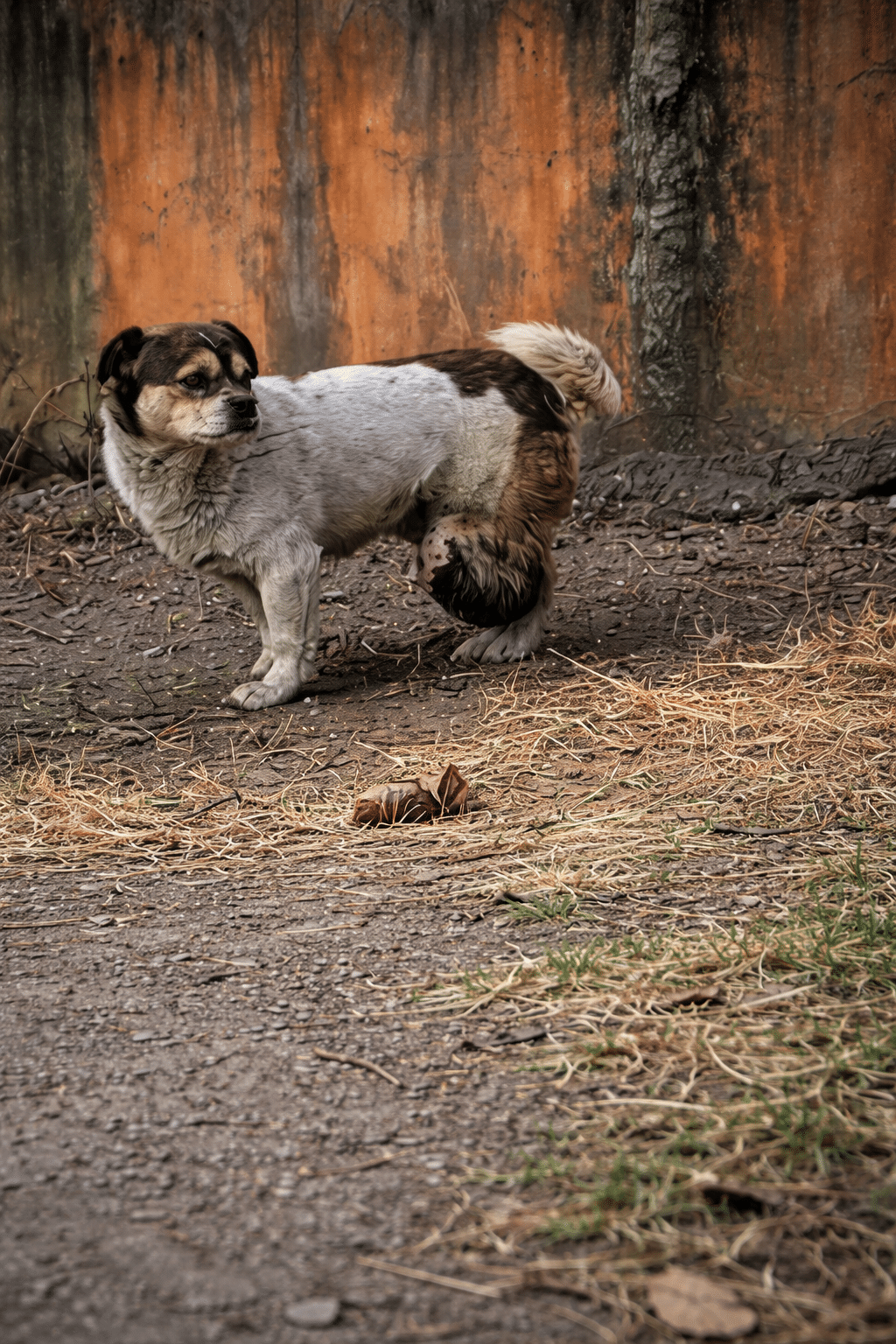
For more than four years, every step this stray dog took was shaped by the enormous mass hanging from his leg.
It had become part of the way he moved.
He could still walk, but nothing about that movement looked effortless. The weight forced him to adjust his body carefully, as though every few steps required another calculation.
For a long time, that was simply how he survived.
Then someone took a photograph.
The Photograph That Finally Brought Attention
The image was sent to people who could help.
It showed a stray dog who had apparently been living around the same streets for years, carrying a growth so large that it was impossible to overlook once someone truly stopped to look.
There was also one small detail that mattered greatly.
A local person had placed a simple foam container outside a home where the dog could find some shelter. It was not an elaborate rescue effort. It was simply an act of kindness offered to an animal that had nowhere else to go.
The dog kept returning.
Because he had a familiar place to come back to, rescuers eventually had a way to locate him.
What had once been nothing more than a small shelter became the connection that allowed help to reach him.
By the time rescuers saw his condition in person, waiting longer no longer seemed reasonable.
The mass had already affected his movement for years.
Now he needed medical attention.
At the Hospital, Fear Came With Him
Reaching safety did not mean he immediately understood that he was safe.
At the hospital, the dog was visibly frightened.
He trembled when people touched him. Sudden movements made him flinch, and he often avoided looking directly at those around him.
His behavior suggested a dog accustomed to approaching unfamiliar situations cautiously.
The veterinary team responded with patience.
They moved carefully around him while completing the examinations needed to understand what he had been carrying for so long.
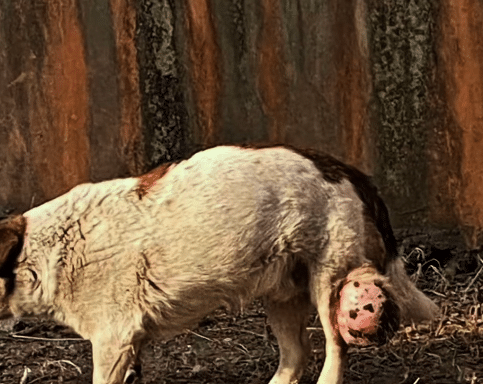
The results confirmed that the tumor was malignant.
There was, however, one important piece of encouraging news.
X-rays showed that although the mass was closely attached around the leg, it had not penetrated the bone.
That finding gave the team an opportunity to act.
Surgery was chosen without unnecessary delay.
For the dog, the next hour would remove a burden he had carried for years.
The Surgery That Changed His Body in a Single Day
The operation lasted a little more than an hour.
Every movement in the operating room had to be controlled and precise as the veterinary team worked around the enormous growth.
Eventually, the mass was successfully removed.
It weighed nearly three kilograms.
For a dog of his size, that was an extraordinary amount of additional weight to carry through daily life.
For years, it had pulled against his body every time he stood, turned, or walked.
Now it was finally gone.
VIDEO: After Carrying a Nearly 3-Kilogram Tumor for Years, He Finally Walks Without Its Weight
Even before he was ready to walk normally again, the physical change was easy to see.
As he recovered from anesthesia, his body no longer had the distorted outline created by the tumor.
He looked different almost immediately.
Smaller in one sense.
Lighter in another.
But surgery had solved only one part of his problem.
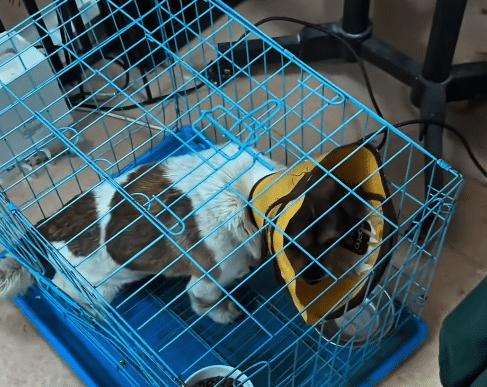
The incision still needed time to heal, and the frightened dog who had arrived at the hospital still had to learn that the people around him were not there to hurt him.
Recovery Happened in Small, Quiet Moments
The first week required careful monitoring.
His surgical area had to remain clean, his medication had to be given as planned, and the people caring for him watched closely for changes.
Yet some of the most important progress could not be measured by looking at the incision.
It appeared in his behavior.
Each day, his rescuer spent time sitting near him.
There was no attempt to force affection.
No sudden reaching.
No demand that he become trusting simply because he had been rescued.
Instead, someone stayed nearby and allowed him to decide how quickly that distance could close.
At first, those moments may have seemed uneventful.
But for a frightened dog, calm repetition can matter.
A quiet voice.
A hand resting nearby.
A person returning again the next day without frightening him.
Gradually, his behavior began to change.
He started finishing his meals more consistently.
He was less likely to press himself into a corner when people approached.
Then came another small signal.
His tail moved.
At first, the movement was slight, but it showed something that medical tests could not capture.
He was beginning to respond differently to the people around him.
The dog who had once tried to make himself unnoticed started lifting his head when someone entered.
Fear had not vanished overnight.
Trust rarely works that way.
It was being rebuilt one ordinary interaction at a time.
Learning How to Move Without the Burden
When the stitches were eventually removed and the surgical area had healed cleanly, another stage of his transformation became clear.
His movement was no longer controlled by the heavy mass that had pulled against his leg.
Walking became more natural.
He could move through rooms without the same awkward compensation.
He climbed stairs by himself.
He explored his surroundings with growing confidence.
For years, his body had adapted to carrying something that should never have been there.
After surgery, he had to discover what movement felt like without it.
The difference was not only visible in the way he walked.
His entire daily world appeared to become larger.
Instead of remaining withdrawn, he became more active and aware of what was happening around him.
At home, he even developed a quiet companionship with the resident cat.
It was a simple relationship, but it represented just how different his life had become.
He was no longer the stray dog people recognized because of an enormous tumor.
He was simply a dog moving through an ordinary day.
Exploring.
Eating.
Climbing stairs.
Sharing space with another animal.
Responding when someone entered the room.
Those moments might seem small beside a major surgery.
For him, they were the life that surgery had made possible.
One Decision Interrupted Four Years of Suffering
Perhaps the most difficult part of his story is the length of time involved.
Four years is not a brief period.
For all that time, the tumor grew into something large enough to change the mechanics of his walking.
Yet the turning point did not begin with sophisticated equipment or a dramatic emergency call.
It began with someone paying attention.
A photograph was taken.
A person shared it.
Someone else had already provided a simple place where the dog could return for shelter.
Then rescuers acted.
Each step alone may have seemed small.
Together, they changed the direction of his life.
The surgery itself lasted only a little more than an hour, but recovery required something different: repetition, patience, medication, observation, and a willingness to let trust develop at the dog's own pace.
That contrast is part of what makes his journey meaningful.
A physical burden that had existed for years could be removed in one operation.
Fear could not.
Fear needed quieter treatment.
It needed safe days repeated often enough for the dog to begin expecting something other than danger.
Finally Free to Be an Ordinary Dog
There is no single moment that completely explains his transformation.
It was the photograph.
The small shelter.
The decision to rescue him.
The veterinary examination.
The discovery that the tumor had not entered the bone.
The successful surgery.
The careful week afterward.
The meals he began to finish.
The first small movement of his tail.
The stairs he could eventually climb without that enormous weight pulling against him.
Each moment became part of the same second chance.
His story is also a reminder of how easily prolonged suffering can become part of the scenery when people grow accustomed to seeing it.
Sometimes an animal does not need everyone to notice.
It needs one person to stop treating what they see as normal.
One person to take the photograph.
One person to provide a place of shelter.
One person to pass the information along.
One person to act.
The dog had carried nearly three kilograms of extra weight attached to his leg for years.
After surgery, that physical burden was gone.
What followed was something quieter but equally important: the chance to experience regular days without it.
No painful adjustment to gravity with every step.
No enormous mass defining his appearance.
No need to remain hidden in a corner when someone entered the room.
Just a dog discovering how different life could feel when care finally arrived.
Sometimes rescue begins with something remarkably simple.
Someone notices.
And instead of looking away, they decide that an animal should not have to keep carrying its burden alone.


