
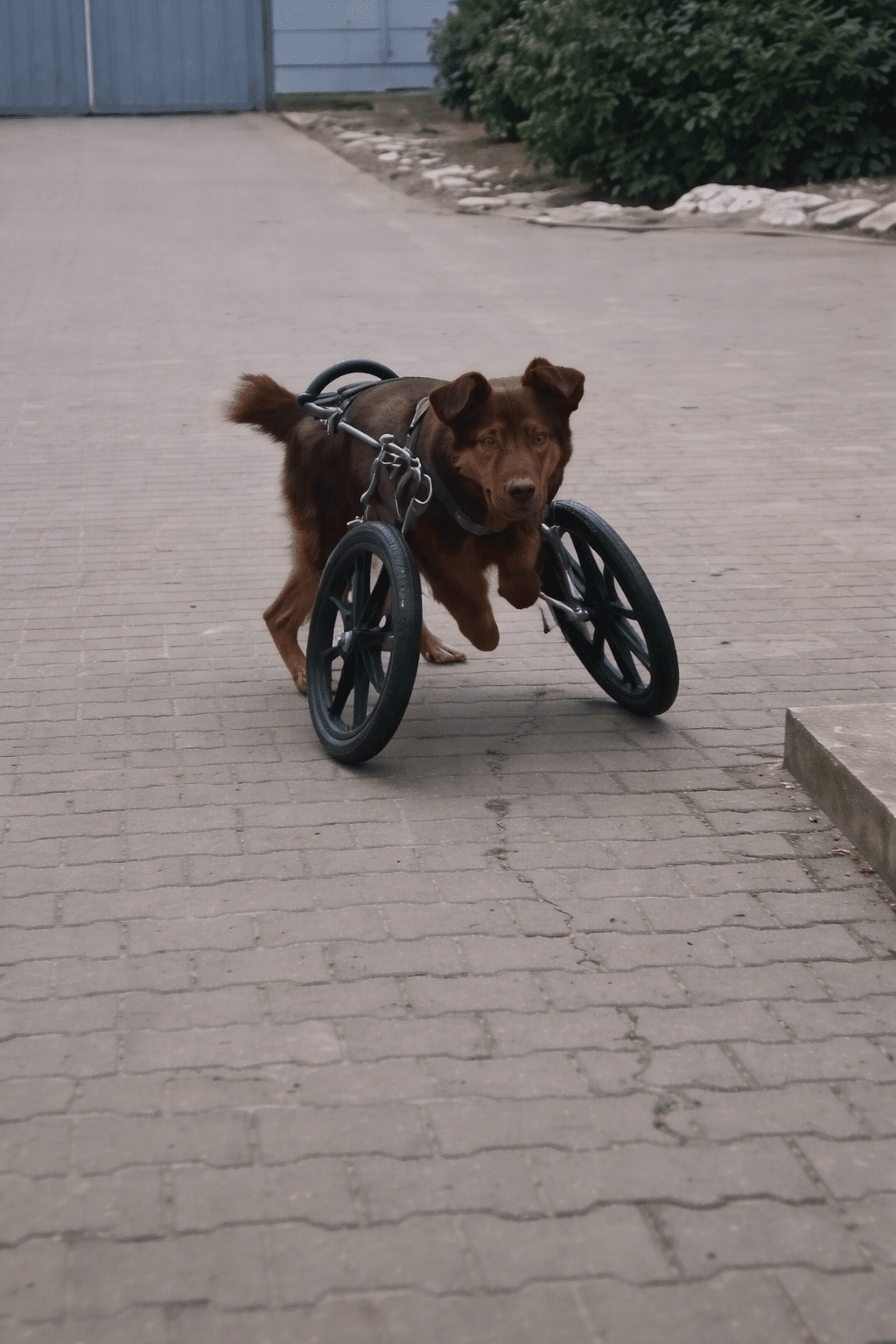
Some turning points leave no possibility of returning to the life that came before.
For Jack, that moment arrived with a devastating accident that took both of his front legs. His injuries were severe, his body was weakened by the trauma, and for a time, even survival was uncertain.
Yet one thing remained.
Jack was still holding on.
That small fact became the beginning of everything that followed.
When Survival Was the Only Goal
By the time rescuers reached Jack, there was no room for hesitation.
He was extremely weak. His breathing was shallow, and the damage to his body required immediate attention. Instead of focusing only on what he had lost, the people caring for him concentrated on the possibility that remained.
He was alive.
And as long as he was alive, there was something worth fighting for.
Jack was carefully cleaned and stabilized before receiving emergency medical care. The injuries to his front legs were beyond saving, and the necessary procedures left him facing a future unlike anything he had known before.
Both front legs were gone.
But the work of helping him had only begun.
The days afterward were not filled with dramatic breakthroughs. They were built from quiet routines.
Rest.
Medication.
Careful checks of his healing body.
And time.
Progress came slowly, sometimes in changes so small that they might have been easy to overlook. Jack remained physically fragile, but there was a steadiness about him.
He continued forward.
Saving His Life Was Only the Beginning
Keeping Jack alive answered one urgent question.
Another soon followed.
How could a dog without either front leg regain enough mobility to experience independence again?
Jack had survived, but simply surviving was not the future his caregivers wanted for him. They wanted him to have the chance to explore, move, play, and participate in life rather than remain limited by the injuries he had endured.
That required a different kind of solution.
A custom wheelchair was created specifically for Jack's body. Two carefully balanced wheels would support the front of him while allowing his remaining legs to provide the movement.
On paper, it offered possibility.
In practice, Jack still had to learn an entirely new way of moving.
The first attempts were uncertain.
He hesitated.
His balance shifted.
He stopped and adjusted.
Nothing about the equipment was immediately natural. Every small movement asked his body to understand weight, direction, and momentum differently than before.
Still, he kept trying.
VIDEO: Jack Lost Both Front Legs — Watch Him Discover a New Life on Wheels
Learning a New Kind of Balance
There was no single moment when Jack suddenly understood everything.
Instead, confidence arrived through repetition.
A little farther one day.
A smoother turn the next.
A better sense of where the wheels would go when his body changed direction.
Those small corrections slowly became skill.
Jack learned how to distribute his weight without the front legs he had once depended on. He learned how to pivot without tipping himself off balance. He discovered how much speed he could create and how to control it.
The wheelchair gradually stopped looking like something attached to him.
It began to look like part of the way he moved.
Then came the kind of change his caregivers had been hoping to see.
Jack was no longer simply maneuvering from one point to another.
He could move with purpose.
And eventually, he could run.
Not by returning to the body he had before the accident.
But by adapting to the body he had now.
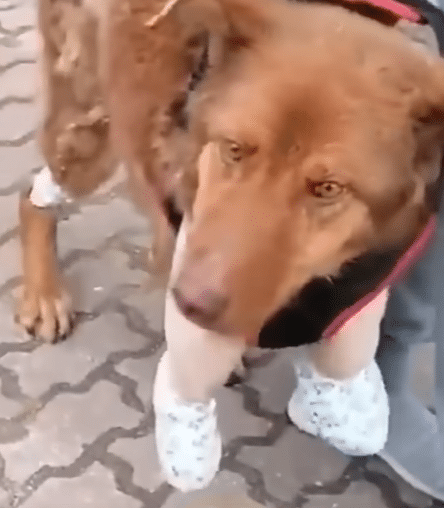
The wheels were not a reminder that his life had become smaller.
They expanded it again.
Instead of struggling to pull himself forward, Jack could build momentum. He could choose where he wanted to go. He could keep moving rather than waiting for someone else to move him.
Independence had taken a different shape.
But it was independence all the same.
The Dog Behind the Injury Began to Reappear
Loss can easily become the first thing people notice about an injured animal.
With Jack, that impression does not last long.
Watching him move today, the accident is no longer the entire story.
There is the sight of him crossing snowy ground with his wheels moving smoothly beneath him.
There are walks alongside other dogs, where he keeps pace rather than remaining behind.
There is curiosity in the way he looks around.
There is energy in the way he approaches movement.
There is playfulness.
The other dogs around him do not seem concerned with counting his missing legs.
Jack is simply there with them.
Moving.
Exploring.
Participating.
That may be one of the most meaningful parts of his recovery.
His world did not disappear when his body changed.
With the right support, he found another way back into it.
What Adaptation Really Looks Like
Jack's progress did not erase what happened to him.
Nothing could restore the two legs he lost.
And the wheelchair did not pretend otherwise.
Instead, it answered a more practical question: what could still be possible?
That distinction matters.
Recovery is not always about returning someone to exactly the way life was before an injury. Sometimes that is impossible.
Sometimes healing means creating a different path forward.
For Jack, that path happened to come with two wheels.
At first, they required patience.
Then practice.
Then trust in his own balance.
Eventually, they became freedom.
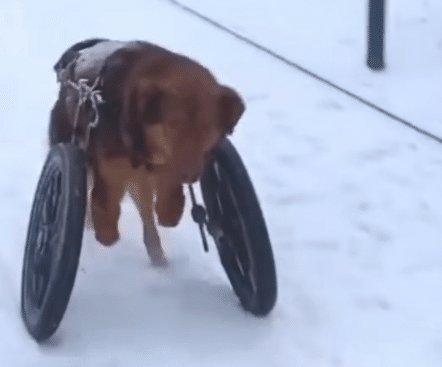
Every turn he learned to make and every stretch of ground he crossed represented something larger than mobility alone.
It meant he could make choices again.
Where to go.
How quickly to move.
Whether to stop or continue.
Those ordinary freedoms can be easy to overlook until they are suddenly taken away.
For Jack, getting them back changed everything.
More Than a Story About What Was Lost
It would be easy to tell Jack's story only through the accident.
Two front legs gone.
A body forced to change.
A future suddenly uncertain.
But doing that would miss the larger part of what followed.
Jack's life became a story of adaptation.
His rescuers and caregivers protected what could be saved. Medical care gave him the chance to recover. A specially designed wheelchair gave him the possibility of movement.
Then Jack had to do the rest.
He had to learn.
He had to adjust.
He had to keep trying when movement felt unfamiliar.
There were no shortcuts that could make those first uncertain attempts disappear.
There was only repetition and patience.
Little by little, the awkwardness faded.
The wheels became familiar.
The unfamiliar became ordinary.
And ordinary movement became something joyful again.
Moving Forward on His Own Terms
Jack's story is powerful not because his injury vanished.
It never did.
It is powerful because the injury did not become the end of everything else.
He still moves through the world.
He still keeps company with other dogs.
He still explores.
He still experiences the simple pleasure of going somewhere because he wants to go there.
The shape of that movement changed.
The desire to live fully did not.
His journey is also a reminder of what thoughtful care can make possible. Compassion alone cannot replace missing limbs, but compassion combined with practical support can open doors that once seemed closed.
For Jack, that meant medical care when he was at his weakest.
Then time to heal.
Then equipment designed around what his body could still do.
And finally, the space to learn for himself.
The result is not a dog frozen in the moment of his accident.
It is a dog moving beyond it.
Jack may travel on wheels now, but the important part is not how he moves.
It is that he can.
And after everything that changed in a single terrible moment, he is still choosing to move forward.


