
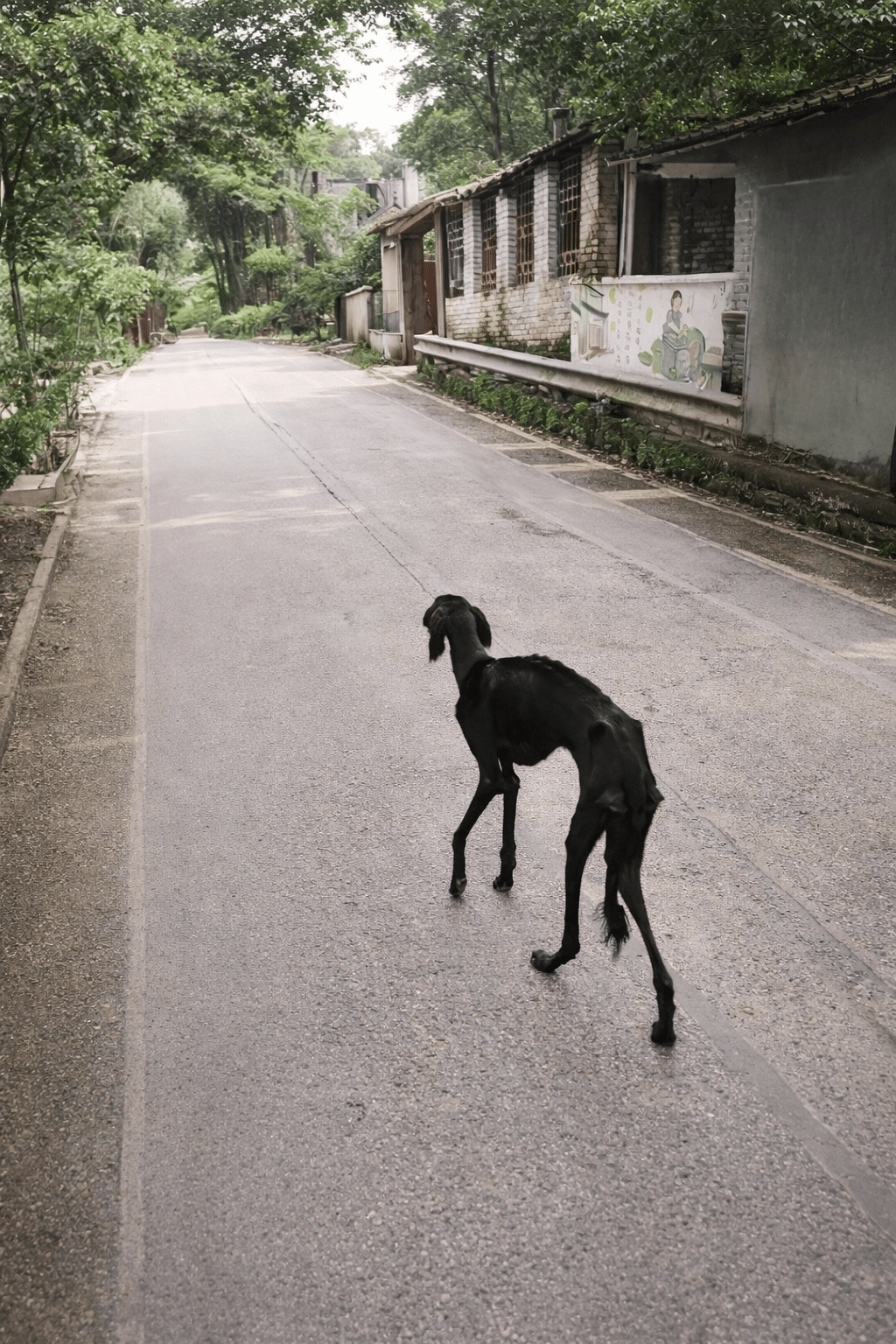
He stood quietly in the doorway, his long black body so thin that every rib seemed to shape the outline beneath his coat.
He did not bark.
He barely moved.
Even remaining on his feet appeared difficult as his back legs trembled beneath him.
The tall hunting dog, possibly an Afghan Hound mix, seemed uncertain about everything around him—including the food placed directly in front of him.
For a dog in such poor condition, hunger should have made the decision simple.
But Jixiang hesitated.
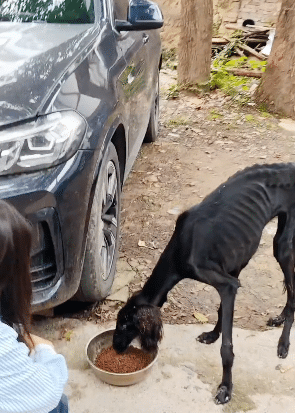
He lowered his head toward the bowl, sniffed carefully, and waited.
That pause said more than frantic eating ever could.
He had reached a place where food was available, yet he still seemed unsure whether it was really his.
A Door Opened When He Needed It Most
The person watching him made a quiet decision.
Instead of leaving the frightened, emaciated dog at the threshold, they opened the door wider and allowed him inside.
There was no dramatic chase or complicated rescue.
Just a fragile dog being given permission to enter.
Warm water was prepared for him. A soft place was arranged where he could rest. Because his body had so little protection from the cold, an old shirt was gently wrapped around him to help keep him comfortable.
Then he received something else he had not arrived with.
A name.
They called him Jixiang, meaning “good fortune.”
At that moment, the name may have sounded almost too hopeful for the dog standing before them.
His body was exhausted.
His legs were weak.
His future was uncertain.
But the name represented something important: the expectation that his story did not have to end where it had begun.
The next challenge was keeping him stable enough to discover what that future might look like.
The First Days Became a Fight for Stability
Jixiang needed veterinary attention quickly.
Examinations confirmed severe malnutrition. An ultrasound also revealed fluid in his abdomen, and there were concerns that he might have a heart-related problem, possibly one present from birth.
His condition required hospitalization.
The change from a doorway to a hospital did not mean the danger had immediately passed. His weakened body needed measured support rather than sudden changes.
Veterinary care included IV fluids, carefully controlled nutrition, medication, and close monitoring.
Through those early days, Jixiang remained strikingly gentle.
He did not respond with aggression.
He did not fight against the people caring for him.
He simply endured.
And amid the uncertainty, another small change began to appear.
He started leaning slightly toward the person who had brought him in.
Sometimes, he gave a soft whine when that person moved away.
It was a subtle behavior, but for a dog who had seemed hesitant even to accept food, that growing attachment mattered.
Someone had opened a door for him.
Now Jixiang was beginning to notice that the same person kept coming back.
VIDEO: Too Weak to Trust a Bowl of Food, Jixiang Began a 30-Day Journey Back to Strength
By the sixth day, his condition had stabilized enough for the veterinary team to allow him to leave the hospital.
He was not completely recovered.
He still needed medication and continued care.
But he was strong enough to begin the next stage somewhere quieter.
He was going home.
Learning That Safety Could Be Permanent
Recovery at home was built around consistency.
Meals were prepared carefully so Jixiang could receive the nourishment he needed without overwhelming his weakened body.
His unusual proportions created another practical consideration.
Jixiang was tall and long-legged, so a large wooden bed was built for him. It gave him enough room to lie down and stretch comfortably instead of folding his body into a small space.
In the beginning, he remained watchful.
There were other dogs in the home.
There were cats as well.
Jixiang moved carefully among them, keeping some distance and observing the unfamiliar household before deciding how close he wanted to come.
Nothing was forced.
That patience gave him time to understand his surroundings at his own pace.
Little by little, the changes became visible.
The trembling began to ease.
His steps grew more stable.
His appetite became stronger.
Instead of remaining apart, Jixiang started following his caregiver from one room to another.
Not frantically.
Not as though he were trying to escape.
He simply wanted to know where this person was going.
Trust rarely arrives in one dramatic moment.
For Jixiang, it appeared in small choices.
Eating when food was placed down.
Resting more deeply.
Walking closer instead of farther away.
Following someone because their presence had become familiar.
Soon, the dog who had once seemed unsure whether he belonged indoors began exploring the home with greater confidence.
He started interacting more naturally with the animals around him.
He began to play.
Most importantly, he learned how to rest without appearing ready to retreat at every movement.
The difference was not only physical.
For the first time in the story, Jixiang seemed to be moving beyond simple survival.
He was learning what it meant to belong somewhere.
The Moment His Long Legs Could Finally Run
As his strength returned, Jixiang was eventually taken outside to an open grassy area.
His first movements were careful.
He trotted rather than raced, testing a body that had recently struggled merely to remain standing.
Then his pace changed.
He ran.
It was not a long sprint.
It did not need to be.
The significance was in the movement itself.
His long legs extended across the grass with growing confidence, revealing the graceful build that had been hidden beneath weakness during those first days.
A dog who had once trembled in a doorway was now moving freely across open ground.
Jixiang also began meeting unfamiliar dogs with calm composure.
Instead of the guarded uncertainty seen earlier, he appeared increasingly comfortable in his surroundings.
Meanwhile, his body continued catching up with his new life.
His weight increased steadily.
The sharp outlines of his bones became less pronounced as healthy tissue returned.
His black coat, previously dull, became smoother and glossier.
Even the way he carried himself changed.
The hunched, uncertain posture of the first days gradually disappeared.
Jixiang began standing tall.
Balanced.
Alert.
Almost regal.
Thirty Days Changed More Than His Appearance
By Day 30, it was difficult to reconcile the dog standing confidently in front of the camera with the trembling figure who had arrived only a month earlier.
His eyes looked clearer and brighter.
His body had regained strength.
His movements carried a calm assurance that had not been there before.
The dramatic contrast naturally drew attention to his physical transformation.
But the quieter changes were just as important.
Jixiang could eat without hesitation.
He could rest comfortably.
He could move through a home shared with other animals without shrinking away.
He could run through grass on legs that had once struggled to support him.
And he had formed a bond with the person who first allowed him through the door.
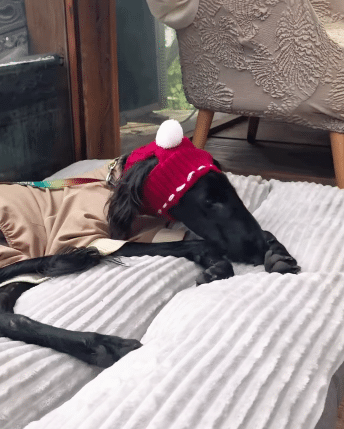
At the end of his 30-day journey, Jixiang could be seen resting peacefully in the sunlight beside his four-legged companions.
There was no need for a dramatic final moment.
His relaxed body told the story.
He was comfortable.
He was secure.
He was home.
Sometimes Rescue Begins With Something Very Small
Jixiang's story did not begin with a complicated operation or a spectacular rescue scene.
It began with a dog standing at a threshold.
He was starving, severely underweight, and physically fragile.
Even when food appeared in front of him, he hesitated.
What followed was not one extraordinary gesture, but a series of ordinary acts repeated consistently.
A door opened.
Food was prepared.
Warmth was provided.
Veterinary care was arranged.
Medication was given.
A bed was built.
Time was allowed.
Day after day, those small acts accumulated.
Within a month, the dog who had barely been able to hold himself upright had rediscovered enough strength to run.
The coat changed.
The posture changed.
The body changed.
But perhaps the most meaningful transformation was the simplest one.
Jixiang no longer stood at the edge of a doorway wondering whether he was allowed inside.
He had a place of his own.
And sometimes, that is where a second chance begins—not with something enormous, but with someone opening the door and making room.


