
The first thing anyone noticed was the way he walked.
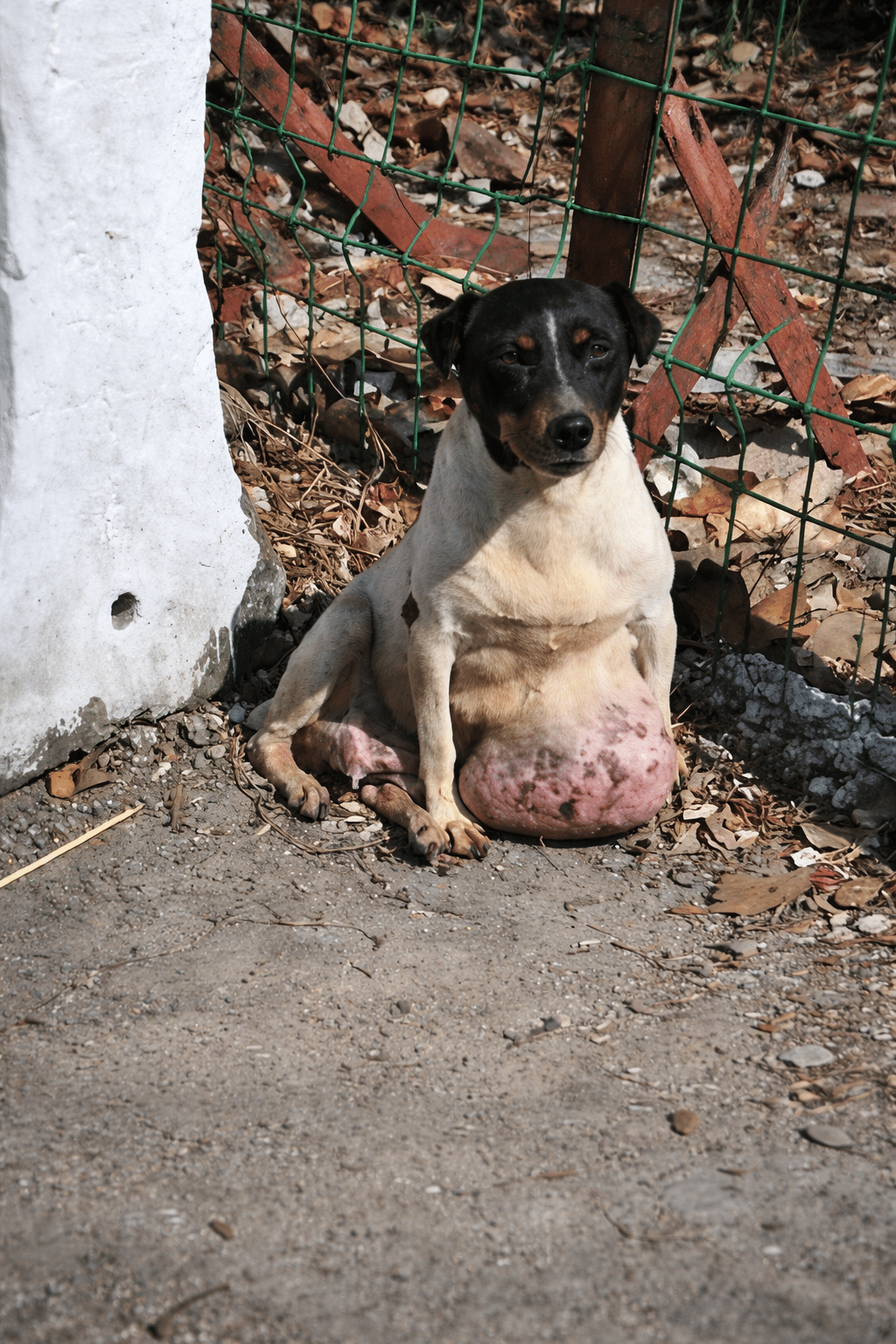
Between moving cars, a black-and-white dog was trying to cross the road one careful step at a time. Beneath his abdomen hung an enormous mass, heavy enough to brush against the pavement whenever he moved.
Every step required adjustment.
The weight pulled downward as he tried to keep his balance. Traffic continued around him, turning an already difficult walk into something far more dangerous.
Yet he kept moving.
He had apparently learned to carry a burden no dog should have been forced to carry alone.
The Moment Someone Finally Stepped In
A rescuer saw him among the passing vehicles and moved carefully into the road to help guide him toward the shoulder.
Only once the dog was away from traffic did the true scale of his condition become clear.
The tumor beneath his body was massive.
It was not something that had appeared overnight, and there was no way for him to escape its weight. Wherever he walked, it went with him, pulling against his thin frame.
The dog did not immediately surrender himself to the stranger who had stopped.
Instead, he slowly moved away.
The rescuer followed at a respectful distance as the dog made his way toward an abandoned farm where he had apparently been staying.
His movements were cautious.
His expression remained guarded.
Whatever his previous experiences with people had been, trust was not something he offered quickly.
But the distance between them began to change when the rescuer offered something simple: water and food.
A chicken drumstick was placed near him.
Eventually, hunger and thirst overcame some of his hesitation, and he accepted what had been offered.
It was a small moment.
But for a dog who had been surviving on his own while carrying such an extraordinary physical burden, accepting help was the beginning of something much larger.
A Past Defined by Usefulness
According to the account of his rescue, this dog had once belonged to someone.
He had reportedly been kept for breeding.
That meant he had not always been a stray wandering between cars or hiding around an abandoned farm. At some point, he had lived around people and had depended on them.
But when his health deteriorated and the tumor became impossible to ignore, that relationship apparently ended.
He was left behind.
There is an important difference between a dog becoming lost and a dog being discarded after he is no longer considered useful.
The source describes his situation as the latter.
By the time someone finally stopped for him, the consequences were visible with every difficult step he took.
Still, the dog had survived long enough for another person to notice.
And this time, someone chose not to walk away.
VIDEO: From Carrying a Three-Kilogram Tumor to Walking Freely Again
The Weight Was Greater Than Anyone Expected
The dog was taken to a veterinary hospital, where his condition could finally be properly assessed.
When he was weighed, the numbers revealed just how extraordinary his situation had become.
His total body weight was only 15.8 kilograms.
The tumor alone weighed close to three kilograms.
That meant the mass represented nearly one-fifth of everything the dog weighed.
For months, according to the story, he had been moving with that weight attached beneath him.
It affected the way he stood.
It affected the way he walked.
It forced him to compensate every time he moved from one place to another.
Removing it would require surgery, and the procedure needed careful planning because of the size of the growth and the tissue involved.
There was no simple shortcut.
The veterinary team had to work patiently and precisely.
The operation was lengthy, but it succeeded.
When the dog woke afterward, he was understandably tired and fragile.
Yet one enormous difference was already visible.
The weight was gone.
For the first time in a long while, there was nothing hanging beneath his body and dragging toward the ground.
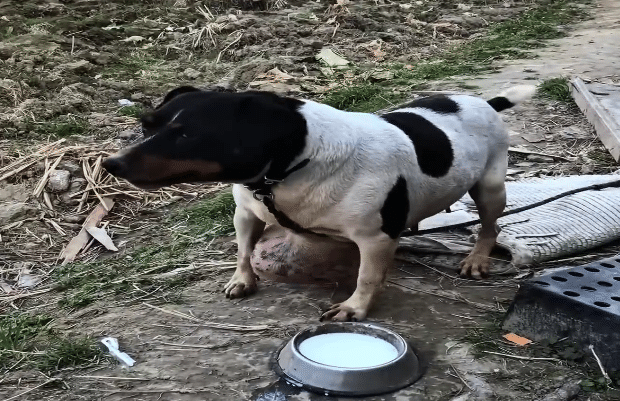
His abdomen now carried the marks of the procedure, but the burden that had dictated every movement was no longer there.
Recovery could finally begin.
Rediscovering What His Body Could Do
Surgery solved the most immediate physical problem, but healing still required time.
The dog needed to regain strength and become accustomed to moving without the massive weight he had carried for so long.
About a week later, he was strong enough to leave the clinic.
A long surgical scar remained along his abdomen.
It was evidence of what his body had endured, but his posture was already beginning to tell a different story.
Walking no longer required the same awkward effort.
His steps were freer.
One of the most meaningful moments came when he encountered stairs.
He stopped.
For a dog whose movement had previously been restricted by such a large mass, even an ordinary staircase presented something unfamiliar.
He hesitated before attempting it.
Then he lifted one paw.
After that came another.
Slowly and deliberately, he began to climb.
Nothing about the moment needed to be dramatic.
A dog walking up stairs is usually an everyday sight.
For him, it represented something entirely different.
It showed what had been returned to him.
Mobility.
Balance.
The ability to explore his surroundings without several kilograms of weight pulling beneath him.
Small Signs That Life Was Becoming Normal
As his physical recovery continued, other changes began appearing.
He became more curious about his surroundings.
Instead of remaining withdrawn, he started exploring his new space.
His appetite improved, and meals disappeared quickly.
His tail moved more often.
His eyes seemed brighter.
The transformation was not limited to the removal of the tumor.
The dog who had once moved cautiously away from the person trying to help him was becoming more comfortable in an environment where care remained consistent.
He even developed an unexpected companionship with a resident cat.
It was another ordinary detail that carried unusual meaning.
His days no longer seemed centered entirely on surviving, finding food, avoiding danger, and compensating for the mass beneath his body.
There was now room for curiosity.
Room for companionship.
Room for normal behavior.
Healing rarely happens in one dramatic moment.
Sometimes it looks like eating a full meal.
Sometimes it is a tail moving a little more often.
Sometimes it is a dog investigating a corner he previously would have ignored.
And sometimes it is simply climbing a staircase that once would have seemed nearly impossible.
A Dog Almost Unrecognizable From the Roadside
By the later stages of the story, he looked remarkably different from the dog first spotted among speeding vehicles.
He appeared steadier.
More comfortable.
More secure in his surroundings.
The rescuer later reflected that helping him had affected more than the dog's life. The experience also changed the rescuer's own perspective.
That is one of the quieter truths behind many rescue stories.
Compassion may begin with one vulnerable animal, but its effect rarely stops there.
The person who chooses to intervene often carries something away from the experience as well: a deeper awareness of how much a single decision can matter.
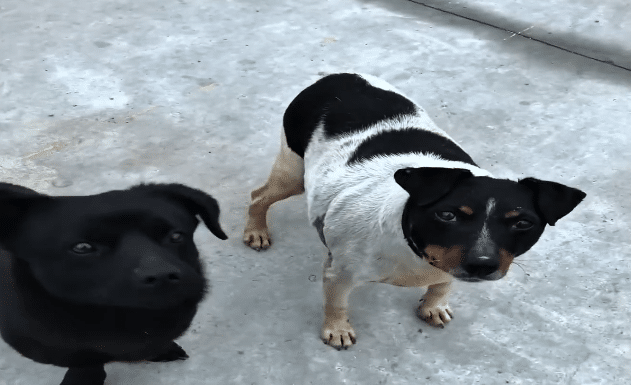
The dog could not explain where he had been or how long he had struggled.
He could not describe what it felt like to carry such a heavy mass while searching for food and shelter.
His body told enough of that story.
But his recovery told another one.
He had gone from carefully navigating traffic with a tumor dragging beneath him to moving freely through a safe space.
He had gone from approaching food cautiously to eating with enthusiasm.
He had gone from struggling with every step to climbing stairs under his own strength.
Those changes happened because someone saw him and decided his life still mattered.
More Than the Removal of a Tumor
The most obvious part of his transformation was physical.
Nearly three kilograms of tumor were removed in one operation.
But surgery alone does not explain everything that followed.
The dog also needed food.
Water.
Time.
A safe place.
And people willing to continue caring for him after the immediate emergency had passed.
That consistency mattered.
His story is also a reminder of something animals should never have to prove: their value does not disappear when they become old, sick, injured, or unable to serve the purpose someone once expected of them.
A dog is not valuable because he can breed.
He is not valuable because he is healthy.
He is not valuable because caring for him is easy.
His life matters before any of those conditions are considered.
For this black-and-white dog, the difference between abandonment and recovery began when one person stopped beside a busy road.
The tumor had become so large that it nearly defined the way he moved.
But it did not define where his story ended.
Eventually, the weight that had dragged beneath him was gone.
And in its place came something far simpler and far more important:
The freedom to walk forward on his own.


