
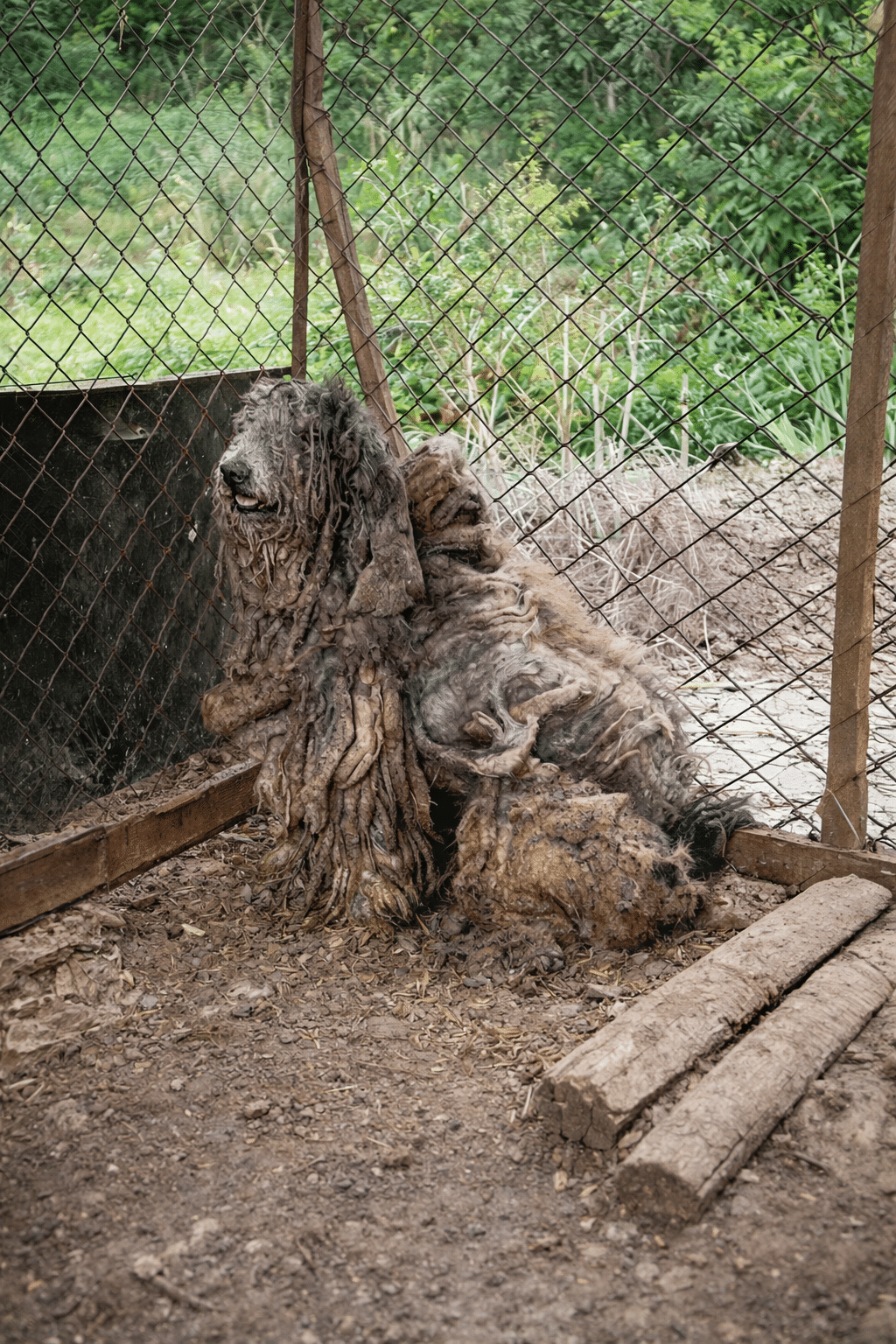
For years, the metal cage behind a small house was almost the only world he knew.
The large dog inside rarely felt grass beneath his paws. His meals were inconsistent, clean water was not always available, and the space around him had gone far too long without proper care.
Eventually, even the people nearby had grown accustomed to the signs of neglect.
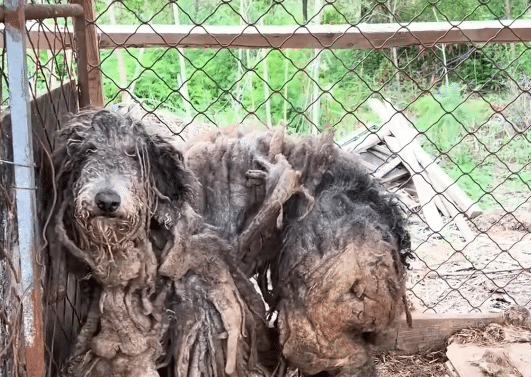
But when rescuers finally came close enough to see him clearly, it was difficult to understand where the dog ended and the tangled coat began.
His fur had become a dense shell of heavy mats, dirt, and moisture.
Beneath it was a body that had been waiting far too long for help.
Behind the Fur, Two Quiet Eyes Were Still Watching
At first glance, the animal inside the cage barely resembled the graceful dog he would later become.
Thick sections of matted fur hung from his thin frame. Years without proper grooming had left the coat twisted into hard layers that concealed much of his condition.
Yet through all of it, his eyes remained visible.
He did not greet the strangers with barking or aggression.
He simply watched.
The cage door opened, but he did not immediately rush toward freedom. Instead, he hesitated at the entrance.
After spending so much of his life inside that confined space, stepping beyond it was something unfamiliar.
The rescuer understood that pulling him out by force would only add more fear.
So he waited.
He crouched near the opening, spoke in a calm voice, and allowed the dog to become accustomed to his presence.
Then, slowly, a hand reached toward him.
For once, the touch that came through the bars was gentle.
The First Hour Outside Revealed How Much Care He Needed
Leaving the cage was only the first step.
The dog’s severely matted coat had to be removed carefully, little by little. The process took more than an hour because the tangled fur was too dense to deal with quickly.
As each heavy section came away, the effects of prolonged neglect became more visible.
His body was extremely thin.
His skin needed immediate attention, and several areas had been badly irritated after so much time living in poor conditions.
The rescuer continued without hesitation, cleaning him carefully and tending to one affected area at a time.
Under the enormous coat was a Giant Poodle.
The breed is often associated with an elegant appearance and an active, intelligent nature. But at that moment, there was little elegance left to see.
What mattered was that he was finally out.
And someone was finally caring for him.
VIDEO: After Four Years in a Cage, This Giant Poodle Finally Felt a Gentle Hand
His Body Was Weak, but He Had Not Stopped Fighting
At the veterinary clinic, the seriousness of his condition became clearer.
He was severely malnourished and dealing with a systemic infection. His temperature was dangerously high, and the examination also found signs of pneumonia and inflammation affecting his liver.
He was experiencing intestinal problems as well.
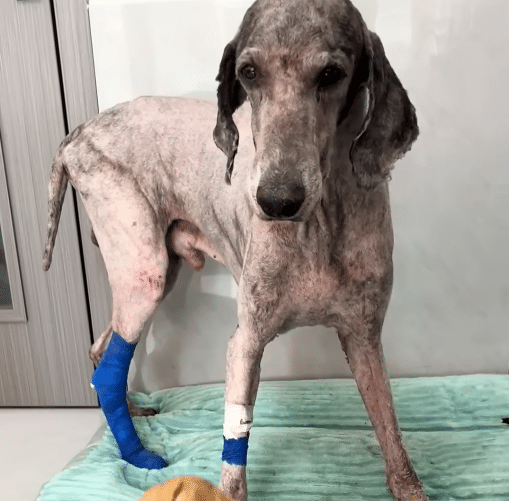
After his heavy coat had been removed, there was almost nothing protecting his thin body from the cold.
He trembled frequently.
A small sweater was placed around him to help keep him warm while treatment began.
Everything about him looked fragile.
Yet he was still there.
He was accepting care.
He was eating when he could.
And despite everything his body had endured, he continued to hold on.
Kindness Was Something He Had to Learn Slowly
Physical treatment could begin immediately.
Trust could not.
During the first days of care, the Giant Poodle did not seem to understand what gentle attention meant.
He did not seek affection.
He did not enthusiastically greet the people around him.
When someone approached, he often became still, uncertain about what would happen next.
There was no need to rush him.
His new routine began with simple things.
Food arrived consistently.
Fresh water was available.
Medication and careful treatment helped his body recover.
No one shouted at him.
No one forced affection upon him.
Day after day, the same message was repeated through actions rather than words: this place was different.
Eventually, his body began responding.
Then came one tiny moment that meant far more than it might have seemed.
The tip of his tail moved.
Only briefly.
It was not yet the joyful wag of a confident dog.
But after years of living within the same metal boundaries, that small movement suggested that something inside him was beginning to change.
Healing Came in Small, Quiet Milestones
Recovery did not happen all at once.
The irritated areas of his skin gradually began improving.
His appetite strengthened, and soon he was finishing his meals eagerly.
As nourishment returned to his body, the ribs that had once been so visible slowly became less pronounced.
His legs became stronger.
His eyes looked brighter.
The dog who had once remained motionless inside a cage began moving through rooms and following his rescuer.
Those changes were important.
But the emotional changes were even more striking.
At first, touch had made him uncertain.
Later, he began leaning toward it.
He discovered that a hand could stroke rather than frighten him.
He learned that being close to a person did not have to mean discomfort.
Eventually, he began resting his head gently on someone’s lap.
For a dog that had spent years confined and largely deprived of ordinary companionship, choosing closeness was a remarkable step.
Six Months Later, the Dog Beneath the Mats Had Returned
Half a year after the cage door opened, the transformation was difficult to miss.
His coat had grown back soft, clean, and carefully groomed.
The fragile posture had been replaced by a more confident stance.
His eyes were alert and expressive.
And the tail that had once offered only the smallest uncertain movement now had reasons to wag.
He could run.
He could explore.
He could play.
The metal cage that had defined so much of his earlier life was no longer around him.
Instead of spending his days confined behind bars, he was discovering ordinary experiences that every dog deserves — movement, companionship, care, and safety.
His recovery was not simply the result of removing years of matted fur.
That was only the visible beginning.
The deeper change came through repetition.
Another meal arriving when expected.
Another gentle touch.
Another day without fear.
Another chance to discover that the world could offer something other than confinement.
Opening the Door Was Only the Beginning
It would be easy to look at his six-month transformation and focus only on the difference in appearance.
The thick mats were gone.
His body was stronger.
His coat had returned.
But the most meaningful transformation could not be measured by fur or weight alone.
A dog who once hesitated at the open door had learned to move freely.
A dog who once froze when people approached had begun seeking their company.
A dog who did not seem to know what affection was had learned to rest his head against someone he trusted.
That kind of healing takes time.
Rescue can begin in a single moment — a cage opening, a hand reaching forward, an animal being carried toward safety.
Recovery is built afterward, through hundreds of quieter moments.
Patience.
Food.
Medical care.
Warmth.
Consistency.
And the simple experience of being treated with dignity every day.
For this Giant Poodle, four years of confinement could not be erased.
But they no longer had to define everything that came afterward.
Someone opened the cage.
Then, day by day, they helped him discover the life waiting beyond it.


