
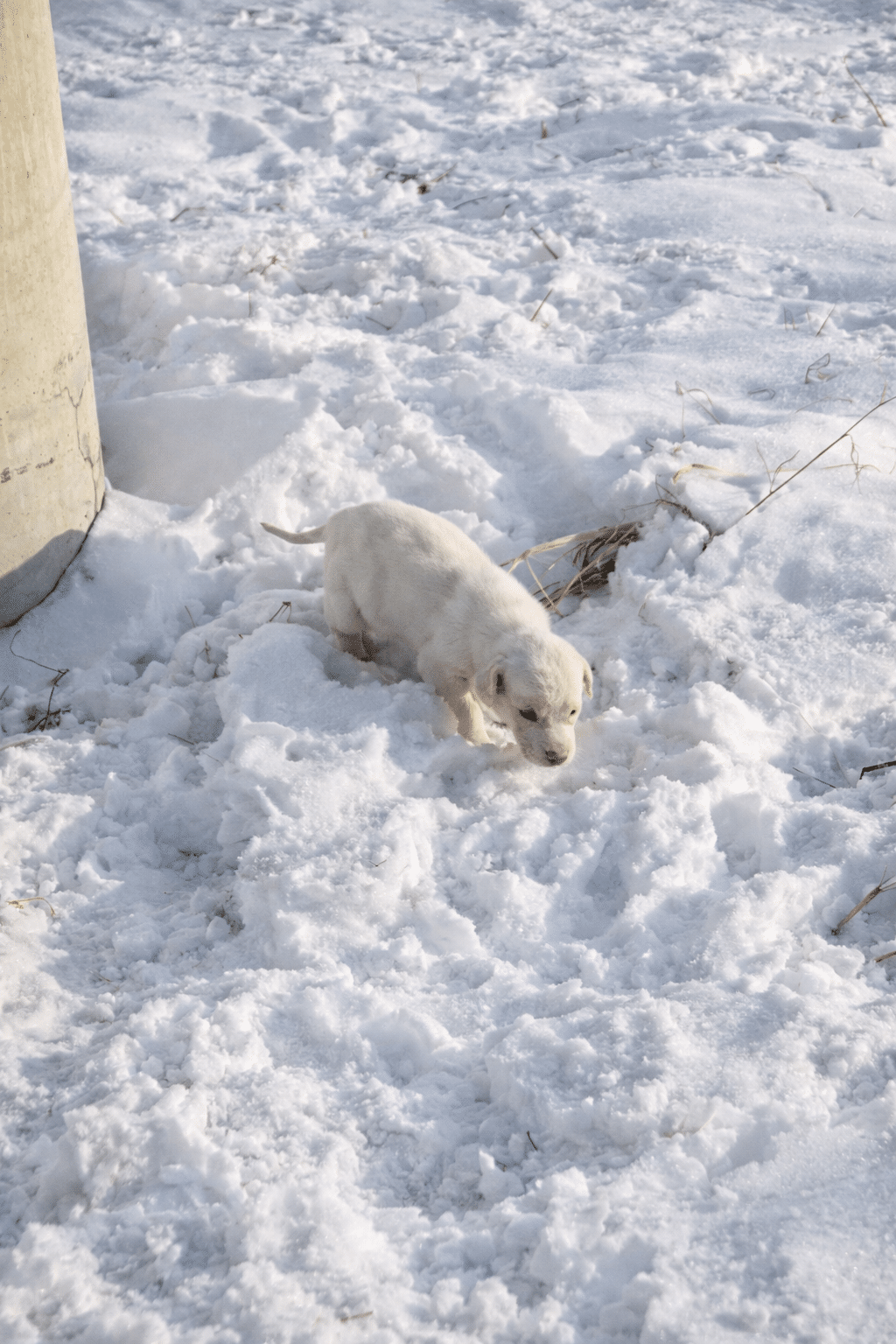
The puppy was so small against the snow that he almost disappeared into it.
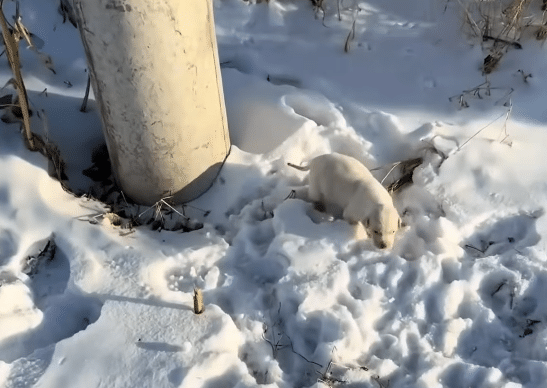
Temperatures had fallen to nearly -13°C, and the hillside was covered in white. Near a solitary utility pole, a passerby noticed what first looked like a scrap of fabric lying motionless against the frozen ground.
Then the tiny shape moved.
It was not a piece of cloth.
It was a puppy.
Barely two weeks old, he was far too young to be outside alone. His white fur was wet against his fragile body, his ribs were visible, and his eyes had only recently opened. He did not yet have the strength to stand properly.
Whatever had happened before that moment was unknown.
What mattered now was simple: he needed warmth immediately.
The Moment a Stranger Realized He Was Alive
The passerby did not continue walking.
He approached the tiny puppy and saw just how vulnerable he was. There was no thick coat protecting such a young body from the freezing air, no mother beside him, and no safe shelter nearby.
The cold had already taken much of his strength.
The man removed his thick winter hat and carefully placed the puppy inside it.
For an animal so small, the hat became more than clothing.
It became shelter.
The soft fabric helped block the wind, while the warmth trapped inside gave the puppy something he desperately needed. As the man carried him away from the hillside, the trembling gradually began to ease.
There was no complicated rescue operation.
No special equipment.
Just one person who noticed a fragile life and decided not to leave him behind.
That decision changed everything.
Keeping a Two-Week-Old Puppy Alive
Bringing the puppy home was only the beginning.
At roughly two weeks old, he still depended almost completely on hands-on care. He was not simply a young dog who needed a bowl of food and a warm place to sleep.
His needs were closer to those of a newborn.
The rescuer obtained goat milk and began feeding him carefully with a syringe. In the beginning, the puppy was too weak to suck reliably from a bottle, so each feeding had to be slow and controlled.
A little milk.
A pause.
Then another small amount.
There was no room for rushing.
The puppy also needed to stay warm and clean while his condition was watched closely.
An alarm was set for every three hours.
That schedule did not stop at night.
Feed him.
Clean him.
Keep him warm.
Check on him again.
Then repeat.
Sleep became secondary to the responsibility of caring for a puppy who had been found with so little strength.
For the rescuer, the days and nights began to revolve around one small body and one quiet goal: help him make it through the next feeding, then the next.
VIDEO: Found Freezing Beneath a Utility Pole, This Tiny Puppy Began an Extraordinary Journey Back to Strength
Small Changes That Meant Everything
Progress did not arrive in one dramatic moment.
It appeared gradually.
Over the following days, the puppy began to show more strength. The body that had once trembled helplessly beneath an open winter sky started responding to regular feeding, warmth, and careful attention.
A veterinarian later offered encouraging news.
Despite such a difficult beginning, the puppy was developing well. His diet could be adjusted as he grew so that his developing bones and muscles continued receiving the nutrition they needed.
That guidance became part of the routine.
Care also included regular bathing every three days to help reduce the risk of skin problems. Each bath was followed by careful drying and warmth.
For a puppy who had once been lying wet in the snow, staying dry and comfortable mattered.
Nothing about the process was rushed.
Every small improvement counted.
A stronger appetite mattered.
A little more energy mattered.
Being able to move with greater stability mattered.
When an animal begins life in such a vulnerable condition, ordinary milestones can feel enormous.
When Strength Began Replacing Survival
Around three weeks after the rescue, the difference was becoming difficult to miss.
His steps were steadier.
His appetite had improved.
His once-fragile frame had begun filling out.
The puppy was no longer simply being carried through each day by constant intervention. He was beginning to participate in his own life.
By day 72, he weighed 5.2 kilograms.
His coat had also changed. The damp, delicate fur seen on the snowy hillside had grown thicker, cleaner, and softer.
Yet the most meaningful transformation was not measured on a scale.
It could be seen in the way he behaved.
The tired, distant expression from the day he was discovered had gradually given way to alertness and curiosity. Instead of lying helplessly in the cold, he now explored his surroundings with energy.
He followed his rescuer through the home.
His tail moved in quick, hopeful bursts.
At times, he would stop and look upward toward the person caring for him, as though checking that the familiar presence was still nearby.
Trust had begun to grow alongside his body.
He Was No Longer Growing Up Alone
The puppy’s world soon expanded again when he was introduced to another dog in the household.
Their first meeting was cautious.
There were slow steps.
Careful sniffing.
Quiet circles as each dog tried to understand the other.
Nothing needed to be forced.
Then the distance between them began to disappear.
Cautious investigation turned into playful nudges.
Before long, they were sharing toys and chasing one another through the rooms.
They also began resting together.
For the puppy, warmth no longer meant being wrapped urgently inside a winter hat because his life depended on it.
Now warmth could mean lying beside another dog in a safe home.
It could mean companionship.
Routine.
Play.
Rest.
The tiny animal once found alone beneath a utility pole now had another dog beside him and a familiar person nearby.
His life had become filled with things that had once been absent: consistency, safety, and company.

The Hill Became the Beginning, Not the Ending
Today, the puppy described in the source is strong enough to run confidently across open ground.
His body no longer trembles from exposure.
His coat is thick and healthy-looking.
He has food, shelter, companionship, and the security of a home where someone pays attention to his needs.
The snowy hillside still belongs to his story.
So does the utility pole where he was noticed.
But those details no longer define his daily life.
They mark the place where everything changed.
A passerby could have mistaken that small white shape for something unimportant and continued on.
Instead, he looked again.
He saw movement.
He understood that a life was there.
Then he removed his hat, wrapped the puppy inside it, and carried him away from the cold.
What followed required far more than a single rescue moment.
There were feedings every three hours.
Interrupted nights.
Careful cleaning.
Warmth.
Veterinary guidance.
Nutrition adjustments.
And weeks of watching a vulnerable puppy slowly become stronger.
That is often what rescue truly looks like.
The first act may happen quickly.
The recovery is built afterward, one ordinary act of care at a time.
For this puppy, survival began with something as simple as a stranger’s winter hat.
But his new life was created by what came after: patience, consistency, and the decision to keep showing up.
The puppy who once could not stand against the freezing cold can now run forward on his own.
And the place where he was almost lost became only the first page of a much warmer story.


