
Some cries for help are almost silent.
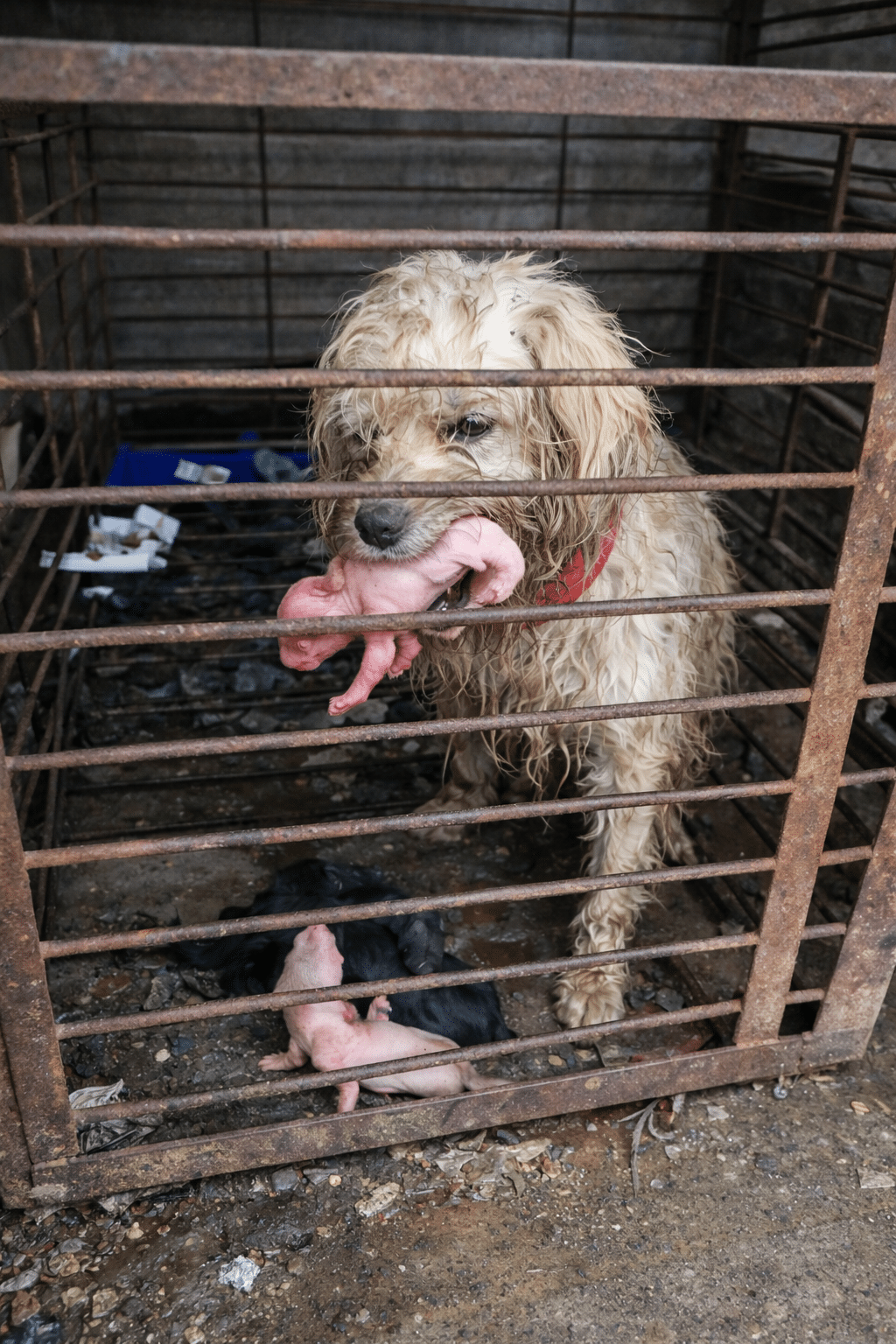
Inside a municipal stray holding center, rows of narrow metal cages lined cold concrete walls. Among the dogs waiting behind those doors was a white mother with newborn puppies.
Then she did something that stopped a visitor in her tracks.
Carefully, the mother picked up one tiny puppy in her mouth. She moved toward the front of the cage and stretched as far as the bars would allow, holding the newborn toward the people standing outside.
There was no frantic barking.
No wild struggle.
Only a mother, a fragile puppy, and a gesture that seemed impossible to ignore.
A Place Filled With Dogs Who Once Belonged Somewhere
The holding center carried a quiet kind of sadness.
Some dogs still wore faded collars. Others had small sweaters on their thin bodies — reminders that at least some of them had likely once lived alongside people.
They may have had familiar routines.
They may have slept inside homes, waited for walks, or recognized the sound of someone returning through a front door.
How each dog arrived there was not always clear. Some may have escaped. Others may have been missing longer than anyone realized.
But inside the facility, all of them were waiting.
The white mother had even more to protect.
Her newborn puppies depended entirely on her, and she remained confined behind the same metal bars as the other dogs.
When visitors approached, she did not lunge at them or bark aggressively.
Instead, she lifted one of her babies.
Slowly, deliberately, she reached toward the gap in the cage.
To the people watching, the movement looked less like panic than a cautious act of trust.
One Visitor Could Not Walk Away
A woman who regularly visited the facility witnessed the moment.
She was familiar with the dogs there. She brought food, spoke gently to them, and spent time kneeling beside cages so frightened animals could approach her hands at their own pace.
She had already seen many forms of fear.
Dogs trembling in corners.
Paws moving anxiously against the metal.
Animals that stayed silent because they seemed too uncertain to come closer.
But the white mother was different.
She was not trying to force her way through the bars.
She appeared to be offering her puppy to the person outside.
The woman remained beside the cage for a long time.
Eventually, she made a decision that would change what happened next: she would bring the mother and her puppies home.
It could not undo the uncertainty they had already experienced.
But it could give them something they did not have inside the holding center — a quieter place, warmth, food, and time.
VIDEO: A Mother Dog Lifted Her Newborn Toward the Bars — And One Visitor Answered Her Silent Plea
Safety Came First, but Fear Did Not Leave Immediately
Leaving the cage did not mean the mother suddenly understood that everything was safe.
Once inside the woman's home, she remained cautious.
The surroundings were different, but instinct still seemed to tell her to protect her puppies by finding the most hidden place available.
She eventually tucked them into a small space beneath the floorboards.
For her, it appeared to be the safest shelter she could find.
The woman provided blankets, food, and gentle reassurance while giving the mother time to adjust.
There was no instant transformation.
Trust had to develop slowly.
The first days also brought painful loss.
Two of the newborn puppies did not survive.
The mother remained near them, licking them softly and refusing to move away for a time.
Rescue had brought the family out of the holding center, but it could not guarantee that every fragile newborn would survive.
It was a reminder of something people involved in animal rescue often face: reaching safety can be the beginning of another difficult stage rather than the end of the struggle.
Still, the remaining puppies needed care.
And their mother needed patience.
Small Changes Began to Show
The woman continued caring for the family without forcing the mother to change faster than she was ready to.
The surviving puppies were kept warm and watched closely.
Gradually, the mother began responding differently to the person helping her.
She accepted food from a hand.
She allowed gentle touch.
She spent less time trying to hide.
None of those changes were dramatic on their own.
Together, however, they showed that the distance between fear and trust was beginning to shrink.
The same dog who had reached through the bars with her puppy was starting to accept help without retreating from it.
That first gesture at the facility now carried even more meaning.
Whether the mother fully understood what the visitor could do for her could never be known.
What was visible was much simpler: she approached the bars with her baby, and someone on the other side chose not to look away.
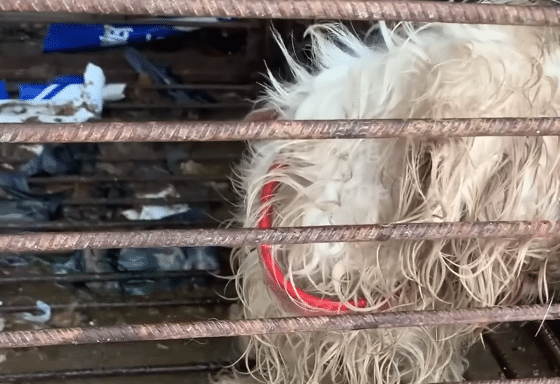
Other Cage Doors Began to Open Too
The white mother and her puppies were not the only animals whose circumstances began to change.
With help from local rescue groups, other dogs at the holding facility also started leaving their cages for foster homes.
One by one, they were given basic care.
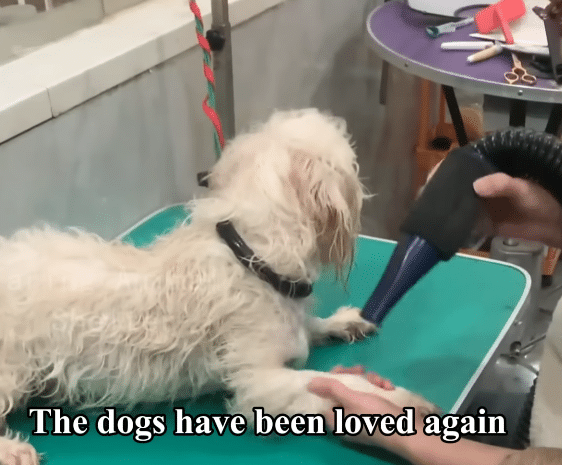
They were bathed.
Their coats were brushed.
Minor skin problems were treated.
The changes did not happen all at once.
Dogs that had seemed frightened did not instantly become relaxed companions simply because they were moved somewhere safer.
But gradually, some of the tension began to fade.
Cautious tail movements replaced some of the stillness.
And cages that had once held waiting dogs began to empty.
Each departure represented a small shift — from uncertainty toward a chance at something better.
For the white mother, however, the biggest surprise was still ahead.
Then Someone Discovered She Was Not Abandoned
Information eventually emerged that changed the meaning of her entire story.
The mother dog had an owner.
She had not been deliberately left behind.
According to the source, she had gone missing more than two weeks earlier during an off-leash walk.
Her family had been searching for her throughout that time.
While she was living behind the bars of the holding center and later caring for her puppies in a temporary home, somewhere else there were people who still wanted her back.
Then came the reunion.
The cautious dog who had needed time to trust unfamiliar people responded immediately when she saw her owner.
She ran toward the person she knew.
Her tail moved rapidly.
Joyful barks came between excited breaths.
Her owner dropped to her knees and wrapped both arms around her.
There was no need to explain recognition.
Her behavior showed it.
After more than two weeks apart, the dog had found the person she remembered as home.
More Than One Rescue Story Was Hidden Behind Those Bars
The mother's journey carries several emotions at once.
There was the uncertainty of the holding center.
There was the unforgettable image of her lifting a newborn puppy toward the bars.
There was the compassion of a visitor willing to bring an entire canine family home.
There was also loss when two of the puppies did not survive.
Then came the slow return of trust.
And finally, there was the discovery that the mother had a family who had never stopped looking for her.
Her story is also a reminder that not every dog inside a stray holding facility was intentionally abandoned.
Some are lost.
Some escape unexpectedly.
Some become separated from families who may be searching desperately for them.
A secured leash can seem like a small precaution, but this story shows how quickly an ordinary walk can turn into days or weeks of uncertainty when a dog gets away.
At the same time, the story shows what one person's attention can accomplish.
The visitor could have watched the mother through the bars and continued walking.
Instead, she stayed.
She noticed the puppy in the mother's mouth.
She recognized that the family needed somewhere safer to go.
And she acted.
That decision did not make everything easy. It did not prevent every loss.
But it gave the mother and her surviving puppies a chance beyond the cage.
And it created the path that eventually led the dog back to the family who had been searching for her.
The moment that remains most difficult to forget is still the simplest one.
A white mother dog standing behind metal bars.
A newborn held carefully in her mouth.
Her body stretched toward a stranger she had no reason to fully trust.
Perhaps no one can know exactly what she intended in that moment.
But someone answered.
And because one visitor did, the mother's story did not end behind a locked gate.
It continued in the arms of the person she recognized as home.


