
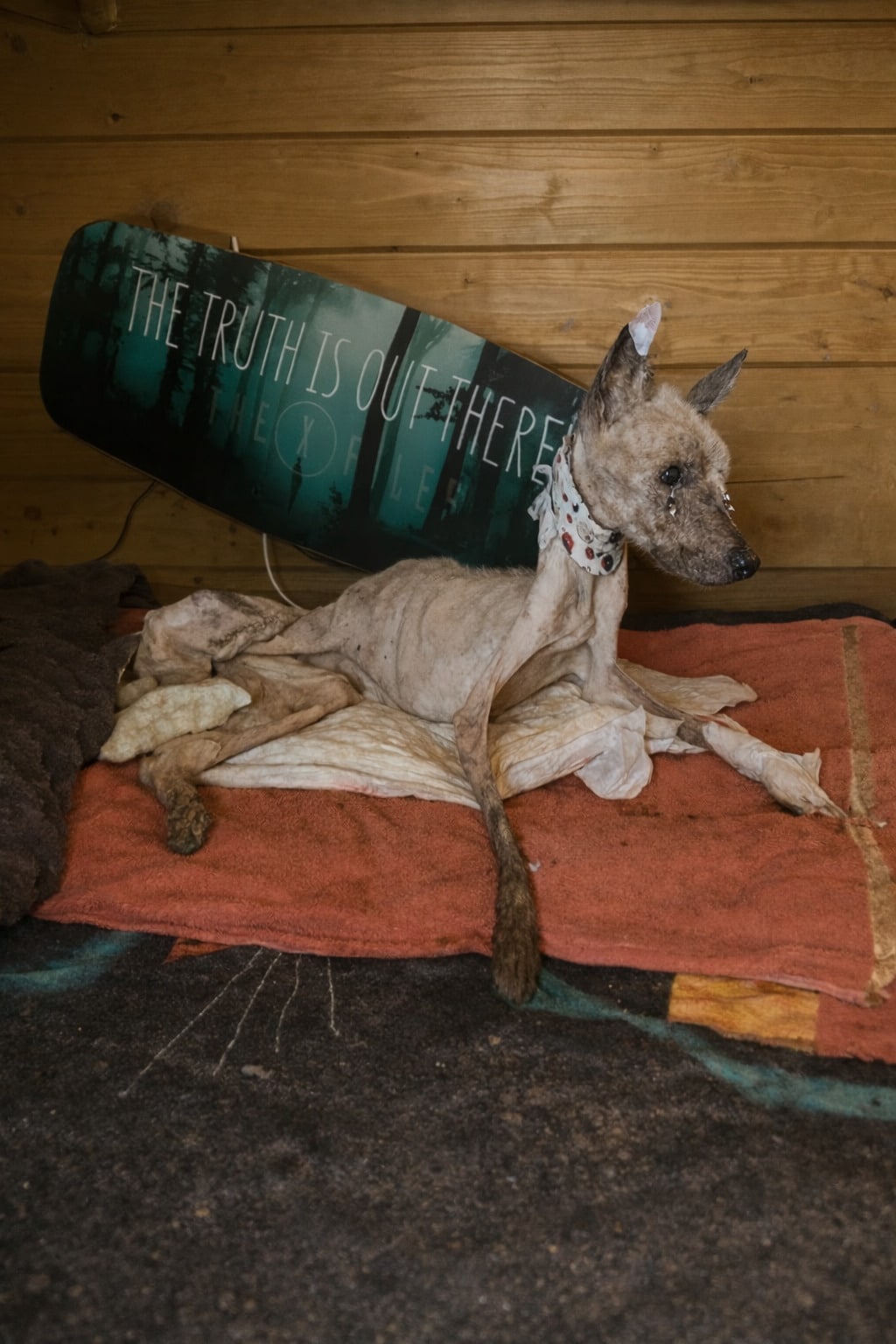
By the time Barsik was found at an abandoned construction site, hunger had already led him into a trap he could not escape on his own.
Somewhere along the way, he had swallowed bait containing a fishing hook. The hook became lodged deep inside his mouth, leaving him unable to eat or drink normally.
He had apparently been living this way for far too long.
When help finally reached him, Barsik was no longer a dog with enough strength to protest. His body was painfully thin. His coat was tangled and dirty. His eyes carried the dull exhaustion of an animal whose energy had almost disappeared.
He did not struggle when he was lifted.
He simply lay still.
Sometimes the most frightening part of a rescue is not panic.
It is silence.
When Hunger Had Taken Almost Everything
Barsik's condition told the story before anyone knew all the details.
His frame had become extremely thin, and even ordinary movement appeared difficult. The object inside his mouth had prevented him from meeting the most basic needs of survival.
Food was beyond reach.
Water had become difficult.
And with each passing day, his body had less strength to keep going.
There was no way to know exactly what Barsik had experienced before he was discovered. What was clear was that he needed professional care immediately.
The person who found him did not leave him in the abandoned construction site.
That decision became the first turning point in Barsik's story.
Soon he was being taken away from the concrete, debris, and isolation that had surrounded him.
For the first time in an unknown number of days, his struggle was no longer his alone.
A Clinic Visit Became an Emergency
At the veterinary clinic, Barsik's condition quickly raised concern.
Beneath his coat, there was very little body weight left. The injury inside his mouth had been present long enough to become seriously infected, and even beginning treatment required great care.
His weakened condition made simple medical procedures difficult.
The veterinary team understood that Barsik needed more support than the smaller clinic could provide.
The decision was made to transfer him to a larger hospital.
There was little room for delay.
What had begun as the rescue of an exhausted dog had become a race to stabilize a body that had been deprived of food and water for far too long.
VIDEO: Barsik Was Too Weak to Eat or Drink — His Fight for Recovery Had Just Begun
The First Signs That His Body Was Responding
At the hospital, Barsik underwent emergency surgery so the fishing hook could finally be removed.
The damaged area was treated, and he also received a blood transfusion as doctors worked to support his fragile condition.
Removing the hook did not instantly undo everything his body had endured.
Recovery had to begin carefully.
One of the first meaningful changes was remarkably simple.
Barsik began drinking water again.
After being unable to drink properly, that small act represented something enormous. His body could finally receive one of the things it had been missing.
Then came liquid food.
There was no dramatic transformation overnight.
Instead, improvement arrived in small pieces.
A little nourishment.
A little more strength.
Another day completed.
Then another.
Over time, his weight began to increase. He gained nearly two kilograms, an encouraging sign after arriving in such a severely weakened state.
For a dog who had once seemed almost motionless in the rescuer's arms, every bit of progress mattered.
His recovery was beginning to feel possible.
But it was not finished.
Just When Things Looked Better, Everything Changed Again
Healing rarely follows a perfect line.
Barsik's story proved that.
On the thirty-fourth day of his recovery, after weeks of gradual improvement, his condition suddenly deteriorated.
He was rushed back into intensive care.
The setback came after so much effort had already gone into helping him regain weight and strength. Yet the people caring for him continued treatment rather than assuming the progress had been lost.
They stayed with him through another uncertain period.
As his condition allowed, gentle physical therapy became part of his recovery. The staff remained close, speaking softly and offering the steady presence of people who had already watched him survive more than once.
There were no guarantees.
There was only the next step.
Then the next.
For Barsik, recovery was no longer measured only by medical procedures or numbers on a scale.
It could also be seen in his ability to keep moving forward after another difficult setback.
Slowly, a Different Dog Began to Appear
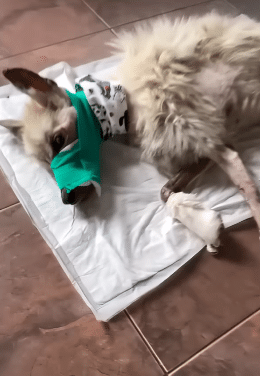
As the weeks passed, Barsik's appearance started to change.
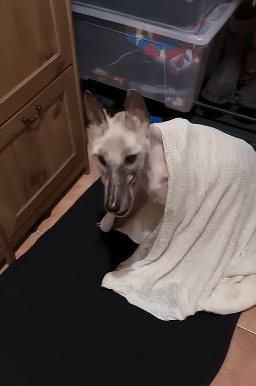
The neglected coat he had arrived with gradually shed away, revealing a dog who looked very different from the exhausted figure found at the construction site.
He was taller than his fragile condition had first suggested.
His legs were long and elegant.
His appearance resembled that of a quiet hunting dog, with an alert, watchful expression that became easier to see as his strength returned.
But the most meaningful transformation was not simply physical.
Barsik learned to walk with confidence again.
The dog who had once lain almost completely still could now move through the world under his own power.
He also began interacting peacefully with other animals.
Dogs became companions.
Even cats could share his space.
Without constant hunger and discomfort defining every moment, more of his natural temperament had room to emerge.
He appeared calm, observant, and gentle.
Recovery had not created a new Barsik.
It had simply allowed people to finally meet the dog who had been hidden beneath exhaustion.
From an Abandoned Site to Warm Sunlight
The later images of Barsik are almost difficult to connect with the dog found at the beginning of his rescue.
Now there is grass beneath him.
Warm sunlight reaches his coat.
Toys sit nearby.
Other animals share his surroundings.
Nothing about those simple scenes is extraordinary by itself.
That is exactly what makes them meaningful.
For a dog whose life had once been reduced to trying to survive with a fishing hook lodged in his mouth, an ordinary peaceful day became something worth noticing.
He did not need another dramatic moment.
He needed safety.
Food.
Water.
Movement.
Companionship.
And time.
Those things had once been uncertain.
Now they were part of his life.
The Quiet Meaning of Barsik's Second Chance
Barsik's story could easily have ended at the abandoned construction site.
By the time someone reached him, he was severely weakened and unable to meet his most basic needs. Even after surgery and early improvement, a serious setback on day thirty-four showed how fragile recovery could still be.
Yet his story continued because care continued.
The hook was removed.
His body received medical support.
He slowly began drinking and eating again.
His weight increased.
He survived another crisis.
He learned to walk confidently.
And eventually, the frightened and exhausted dog seen at the beginning gave way to a calm animal resting in the sun.
Rescue is sometimes described as one dramatic moment when an animal is carried away from danger.
Barsik's journey shows something quieter.
The first rescue mattered enormously, but so did everything that followed.
The hospital transfer.
The surgery.
The transfusion.
The careful feeding.
The weeks of observation.
The physical therapy.
The decision to continue when his condition suddenly worsened.
His second chance was built from all of those moments together.
Today, the abandoned construction site belongs to Barsik's past.
The fishing hook no longer controls whether he can eat or drink.
The thin, exhausted body that once barely moved has changed.
What remains is a dog able to lie in the sunlight, surrounded by grass, toys, and companionship.
For Barsik, that quiet scene may be the clearest sign of how far he has come.
He was once found in a place where survival had become almost impossible.
Now he finally has the chance to simply live.


