
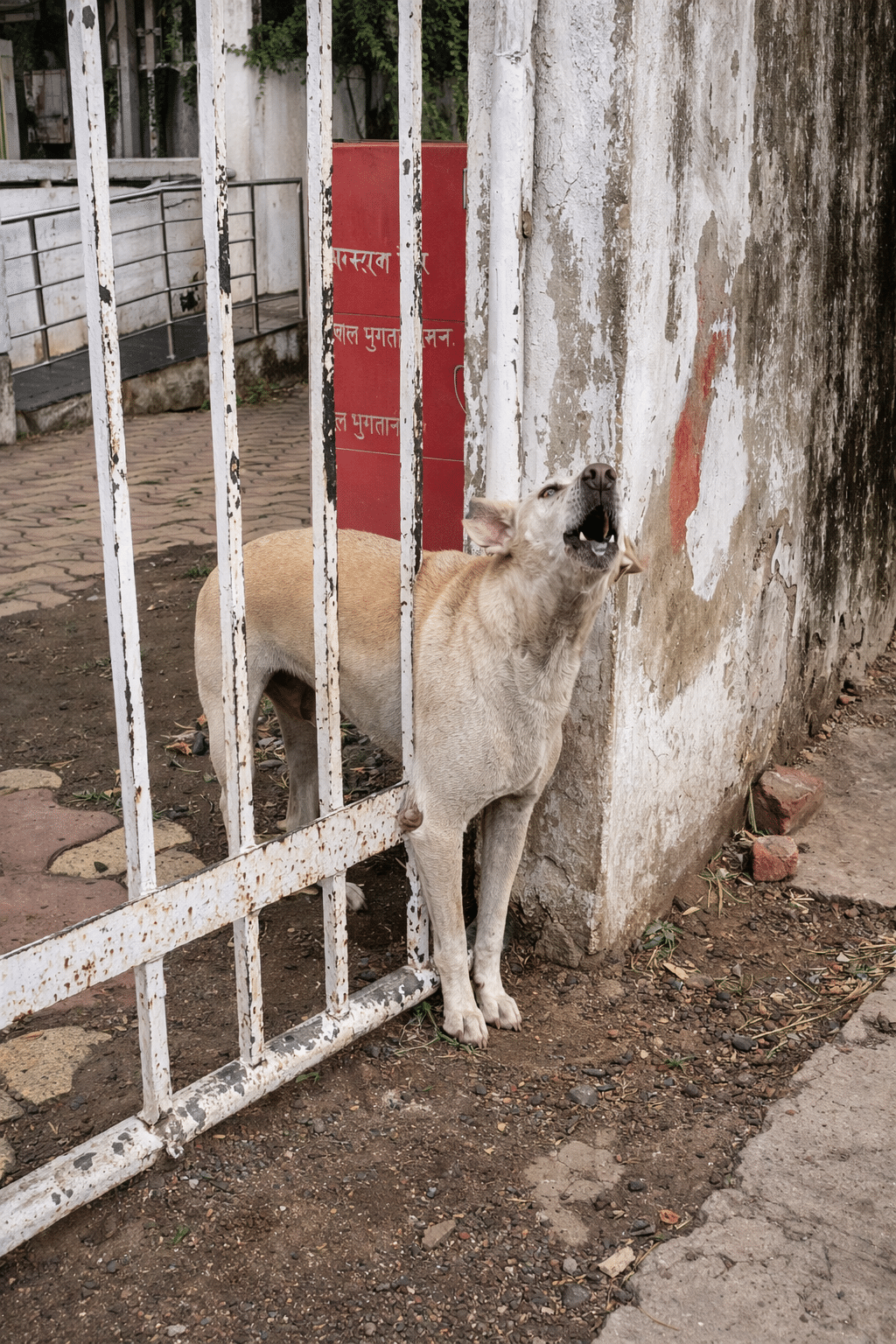
At first, the barking was the only thing anyone could focus on.
Behind a white metal gate, a stray dog was tense, loud, and clearly distressed. His teeth showed as he struggled against the barrier, making him look like an animal that would be dangerous to approach.
But the closer people looked, the clearer the situation became.
He was not guarding the gate.
He was stuck inside it.
The Barking Was Coming From Fear
At some point, the dog had tried to push his body through a narrow opening between the metal bars.
He had made it only part of the way.
His body was wedged tightly between the bars, leaving him unable to continue forward or pull himself back. Each attempt to struggle free only seemed to increase his fear.
The barking continued.
To someone seeing only his reaction, it might have sounded threatening. Yet his behavior made much more sense when the physical problem became visible.
He had nowhere to go.
He could not escape the metal holding him in place, and he could not understand what the approaching people intended to do.
Fear can look very different from one animal to another.
Sometimes it appears as trembling or hiding.
Sometimes it sounds like barking.
And sometimes, when an animal feels trapped with no way out, fear can look remarkably similar to aggression.
Help Arrived Without Rushing Toward Him
Building staff contacted people who could help, and rescuers from Rescue Foundation Gujarat later arrived at the scene.
They did not immediately reach through the gate or try to pull the dog free.
Instead, they stopped and watched.
His body was tense. His eyes were alert. He was barking and showing his teeth while still pinned between the bars.
Those signals mattered.
The rescuers understood that even an animal that needs help can bite when frightened enough. The goal was not simply to remove him from the gate as quickly as possible.
They had to free him without allowing panic to make the situation more dangerous for either the dog or the people assisting him.
That required patience.
It also meant recognizing the difference between a dog seeking confrontation and a dog trying desperately to protect himself because he could not escape.
VIDEO: Trapped Between the Gate Bars, His Frantic Barking Faded as Rescuers Moved Closer
Creating Enough Calm to Begin
The team used a humane catch pole to maintain a safer distance while gently controlling the dog's head.
A volunteer also placed a soft cloth around his muzzle temporarily so that he could not bite someone during a sudden moment of panic.
The restraint was not punishment.
It was a safety measure that allowed rescuers to work close to a frightened dog whose movement was already severely limited by the gate.
They continued carefully.
The rescuers spoke calmly and offered him small pieces of food, giving him time rather than immediately forcing his body through the narrow space.
Little by little, his reaction began to change.
The barking eased.
His body became slightly less rigid.
For the people trying to help him, that small reduction in panic created the opportunity they needed.
The Most Delicate Part Was Still Ahead
Getting him calm enough to work around was only the beginning.
The dog had entered the narrow opening in a way that now left his body trapped, so rescuers had to guide him back through that same space.
Nearby people joined the effort.
They worked carefully around his head and front legs, slowly helping him move backward rather than pulling without control.
There was little room for error.
Moving too quickly could frighten him again.
Using too much force could make an already uncomfortable situation worse.
So the rescue progressed one small movement at a time.
Hands adjusted.
The dog's position shifted.
Everyone waited when necessary.
Then they tried again.
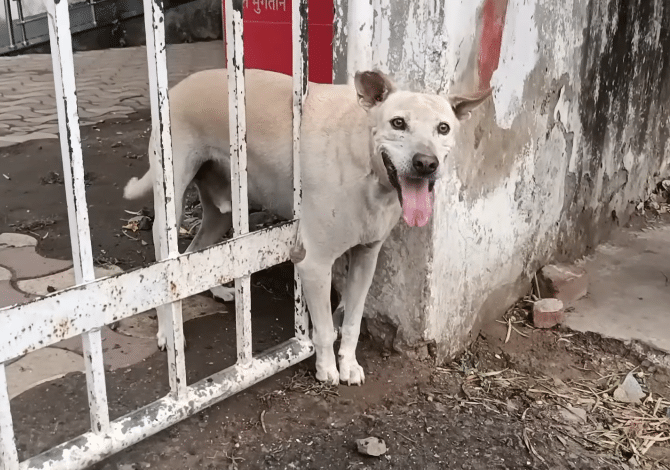
Finally, his body cleared the metal bars.
After being held in one frightening position for so long, he was free.
Freedom Did Not Instantly Erase His Fear
Once the temporary cloth restraint was removed, the dog's first response was simple.
He ran.
It would have been easy to interpret that reaction as rejection, but fear does not disappear the moment danger ends.
From the dog's perspective, he had been trapped, surrounded by unfamiliar people, restrained for his own safety, and physically guided through a narrow opening.
The rescuers knew that freedom did not automatically mean he was ready to trust them.
So they did not chase him.
They did not try to corner him for another interaction.
They allowed distance to become part of the rescue.
That choice mattered because helping a frightened stray is not always about getting closer.
Sometimes kindness means knowing when to step away.
They Returned With Something Simpler
Later, the volunteers came back to the area.
This time, there was no difficult extraction to perform and no reason to restrain him.
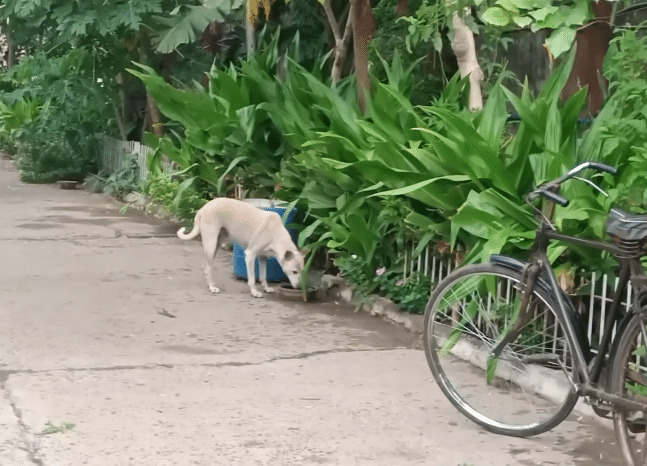
They simply left food and water in a safer place nearby.
It gave the dog the chance to approach on his own terms.
According to the source, changes gradually became visible in the way he carried himself.
His posture became less tense.
The constant barking quieted.
His eyes no longer seemed to scan his surroundings with the same intensity.
These were modest changes, but with a frightened stray, modest changes can be meaningful.
No dramatic transformation was required.
He simply appeared more comfortable than the dog who had been trapped behind the gate.
A Frightened Dog Can Be Easy to Misunderstand
The first impression of this dog could have told the wrong story.
He barked loudly.
He showed his teeth.
He looked difficult to approach.
But none of those things changed the central fact of what had happened.
He was stuck.
With his body trapped between metal bars and no way to move forward or backward, his defensive behavior was understandable.
The rescuers responded by looking beyond the noise.
They controlled the immediate risk without treating him harshly. They waited for small signs of calm. They worked together to guide him free, then gave him space when he ran.
That patience turned a tense encounter into a successful rescue.
The story is also a reminder that behavior should be understood in context.
A snarl does not always mean an animal wants to attack.
A bark does not always mean a dog is dangerous.
Sometimes the loudest reaction comes from an animal who feels completely powerless.
Behind the gate was not a violent stray looking for a fight.
There was simply a frightened dog who could not free himself.
And what he needed most was someone willing to notice the difference.


