
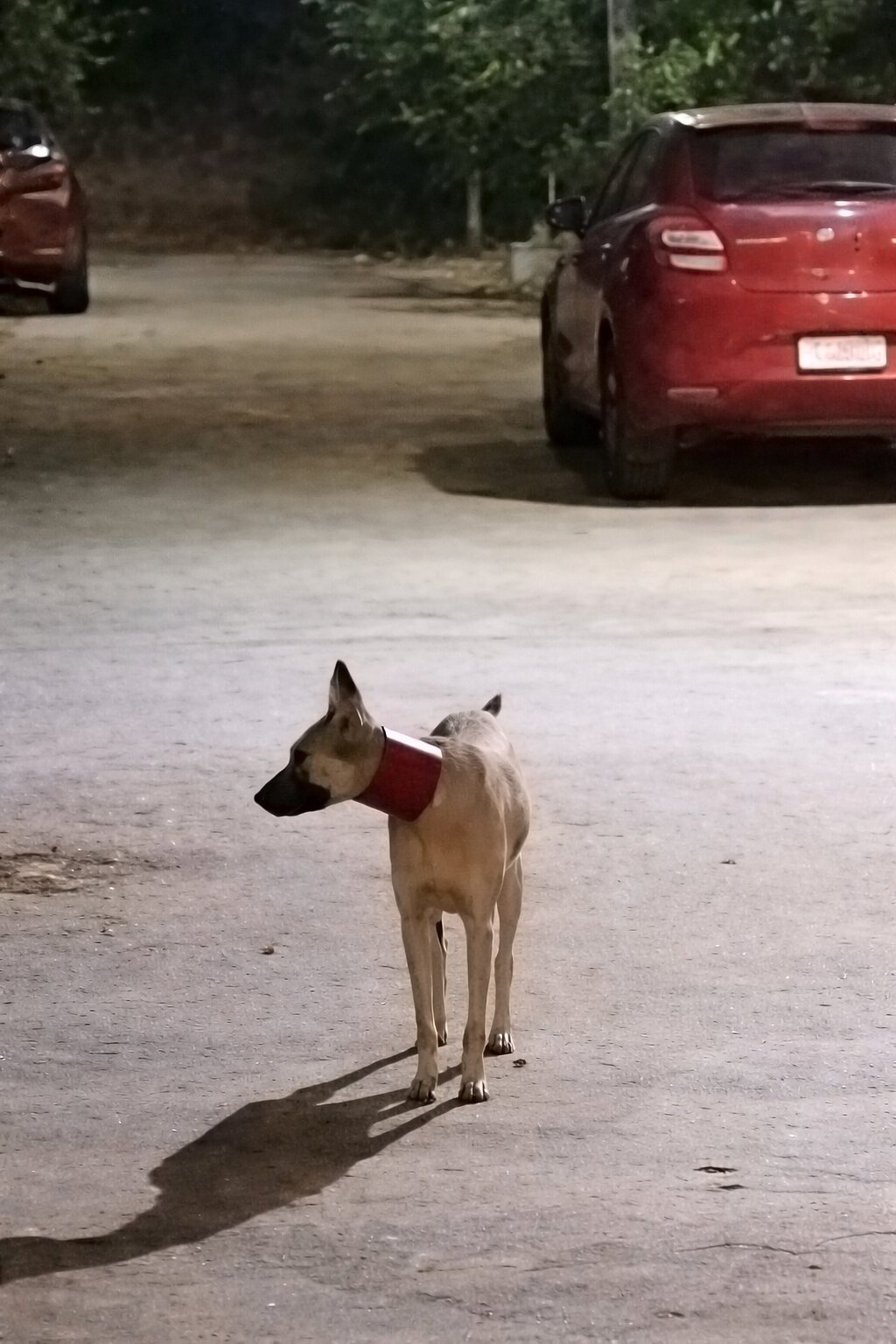
The streets were nearly empty when the dog appeared beneath the dim glow of the streetlights.
Around his neck was something that clearly did not belong there.
A thick piece of black plastic pipe had become lodged around him, sitting rigidly against his neck as he moved through the darkness. He could still walk, but every step had to be made while carrying an obstacle he had no way to remove by himself.
There was no way to know exactly how the pipe had become trapped around him.
What was clear was that leaving it there could put him at greater risk.
A Burden He Could Not Escape
For a stray dog already navigating the uncertainty of the streets, the plastic ring created another problem with every movement.
It was hard and inflexible.
Instead of moving naturally, the dog appeared to compensate for the object around his neck. The pipe restricted the space around him and could continue rubbing against his skin as he walked.
He had adapted enough to keep moving.
But adaptation was not the same as safety.
Someone needed to intervene.
Helping Him Without Frightening Him Away
When rescuers noticed the dog, the challenge was not simply reaching him.
They had to get close without causing him to panic.
A frightened stray can disappear quickly, especially at night. Sudden movement or an aggressive chase could have sent him farther into the darkness or toward a more dangerous area.
So the rescuers chose patience.
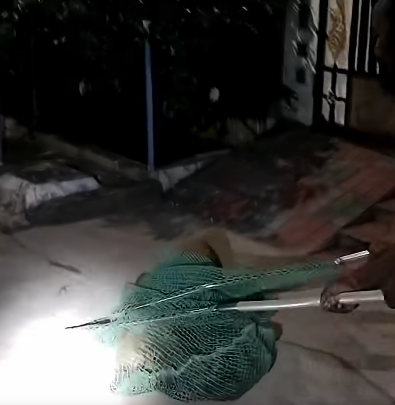
They approached carefully and used a large rescue net to guide and contain him. Their movements were controlled rather than rushed, giving them the chance to secure the dog without turning the rescue into a chaotic pursuit.
Once he was safely contained, they could finally examine the object around his neck more closely.
VIDEO: Rescuers Carefully Cut Away the Plastic Ring That Had Trapped Him
One Careful Cut at a Time
Up close, the difficulty of the situation became even clearer.
The plastic was thick and strong. It was not something that could simply be pulled apart or slipped over the dog's head.
Cutting it away required precision.
The rescuers positioned their tools carefully, keeping enough distance between the cutting edge and the dog's neck to avoid causing additional harm.
Then they began working through the plastic.
Slowly.
Steadily.
One controlled cut at a time.
The dog remained tense inside the net, but he stayed remarkably still while the rescuers worked around him.
That stillness mattered.
Every careful second brought them closer to removing the object without turning the rescue itself into another source of danger.
The Moment the Pressure Finally Disappeared
Eventually, the final section of plastic gave way.
The ring loosened.
Then it came free.
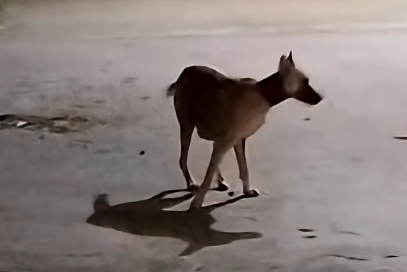
For the first time since rescuers had seen him, there was nothing rigid pressing around the dog's neck.
The difference could be seen almost immediately.
He raised his head more naturally, no longer forced to carry the awkward weight and restriction of the plastic pipe.
It was a simple physical change, but an important one.
Something he had been unable to escape on his own was finally gone.
Back Into the Night, This Time Unburdened
After the plastic had been removed, the rescuers released the dog from the net.
At first, he stepped away cautiously.
That hesitation was understandable. In only a short period of time, strangers had approached him, contained him, handled the object around his neck, and used cutting tools close to his body.
But nothing was holding him anymore.
His movements soon became more confident.
Within moments, he was able to trot away into the night without the heavy plastic ring restricting him.
Sometimes Rescue Is One Precise Moment
Not every rescue ends with a long medical journey.
Sometimes the most important thing is noticing a problem before it becomes worse.
In this case, the dog needed people willing to stop, assess the situation, and work carefully enough to remove something he could never have taken off himself.
There was no dramatic procedure afterward.
No complicated recovery was described.
Just a stray dog entering the night with a dangerous object around his neck—and leaving the encounter able to move freely again.
It was a small intervention measured in minutes.
For the dog, however, it changed every step that came afterward.
A little patience, coordinated teamwork, and one careful act of compassion were enough to remove a burden he had been carrying alone.


