
A frantic bark echoing through a quiet wildlife sanctuary was the only warning that something was terribly wrong.
On an April morning in 2024, a visitor walking through the Frank Niederwerfer Wildlife Sanctuary in South Windsor, Connecticut, heard the sound coming from deeper among the trees.
It did not sound like an ordinary dog calling out.
There was urgency in it.
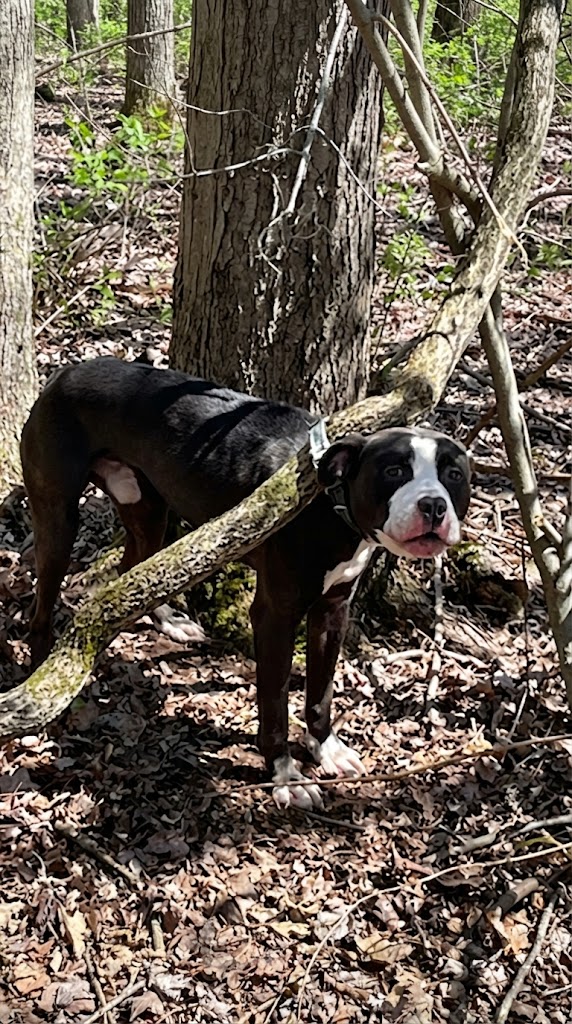
The visitor followed the barking until they found a Pitbull mix standing against a narrow tree. At first glance, it might have looked as though someone had simply tied the dog there.
But the reality was far more troubling.
His collar had been fastened directly around the tree trunk.
There was almost no room for him to move.
A Dog Trapped in One Position
The tree was only about four inches thick, but the way the collar had been secured left the dog unable to comfortably sit or lie down.
Standing was essentially his only option.
Each attempt to lower his body increased the pressure around his neck.
Animal control officers who responded to the scene soon realized that this was not a situation in which a dog had simply slipped loose or become accidentally tangled.
The name Kobe was visible on his collar.
Based on his condition, officers believed he may have been trapped there for approximately six to twelve hours.
For all of that time, the same simple movement that should have allowed him to rest created even more pressure.
Officer Kaley Curtis later explained that when Kobe tried to lie down, the position of the collar placed pressure on his neck and made breathing more difficult.
His eyes were bloodshot, another visible sign of the strain he had endured.
Yet somehow, his barking reached someone.
And someone chose to follow it.
That decision changed everything.
VIDEO: His Bark Led a Stranger Into the Woods — Where Kobe Was Found Trapped Against a Tree
From the Woods to a Place of Safety
Once Kobe was removed from the tree, the immediate danger was behind him.
But his story quickly became much larger than one rescue call.
News of the discovery spread across Connecticut, drawing attention from animal advocates and members of the community who wanted to know how a dog had ended up in such a helpless position.
Authorities began searching for information about the person responsible for leaving him there.
A $5,000 reward was offered for information leading to an arrest.
While investigators focused on finding answers, the people caring for Kobe focused on something different.
They wanted to help him move forward.
At the shelter, he began receiving care for the effects of what had happened to his neck. He also had time to rest after the hours he had spent unable to comfortably change position.
Then came a small but meaningful decision.
Caregivers began calling him Obe.
The “K” was removed from Kobe, giving him a slightly different name for a new chapter of his life.
It was a symbolic change rather than a medical one, but it reflected what everyone around him hoped for: that his future would be defined by something other than the tree where he had been found.
The Gentle Dog People Met After the Rescue
Considering what Obe had experienced, shelter workers might have expected him to be deeply withdrawn or wary of everyone around him.
Instead, the dog they came to know remained remarkably social.
He greeted people with a wagging tail.
He was described as sweet and friendly.
There was no dramatic transformation required before people could see the affectionate personality already present in him.
That contrast became one of the most memorable parts of his story.
A dog had been left in a position where even resting became difficult, yet once he was safe, he still welcomed human attention.
His behavior did not erase what happened.
But it showed that the experience had not taken away his ability to connect with people.
His Story Became a Warning About Abandonment
As Obe recovered, animal advocates used his case to emphasize a broader message.
Leaving an animal behind is never a safe answer to a difficult situation.
Rescuers with Desmond's Army pointed out that alternatives exist for people who can no longer care for a pet.
Families may face financial pressure, housing problems, unexpected expenses, or circumstances that make keeping an animal difficult. Those challenges can be real.
But a dog cannot understand why it has suddenly been left somewhere alone.
And placing an animal in a location where it cannot seek food, shelter, or help can quickly create danger.
Advocates encouraged struggling owners to contact shelters and rescue organizations, join waiting lists when necessary, and ask for assistance before the situation reaches a crisis.
The message was simple:
Ask for help before abandoning an animal.
For Obe, that message carried special weight because he had not merely been left in a public place where someone might quickly notice him.
He had been secured to a tree inside a wildlife sanctuary, unable to freely move away.
If the visitor had not heard his barking, there is no way to know how much longer he might have remained there.
One person paying attention made the difference.
Ten Days That Gave Him Time to Recover
Obe remained at the shelter during the required 10-day holding period.
During that time, he received medical attention for his neck and was given the opportunity to recover in safety.
He also became something of a local figure.
People called the shelter.
They asked how he was doing.
They checked for updates.
Dozens of people wanted to know what would happen to the dog whose barking had carried through the sanctuary.
For a dog who had been left alone against a tree, the change was striking.
Now people were actively looking for him.
They were asking about him.
They cared whether he was comfortable and safe.
The circumstances of his rescue brought attention to the worst moment of his story, but the days afterward revealed something equally important: a community was willing to care about what happened next.
The News Everyone Had Been Hoping For
Eventually, the question surrounding Obe's future received the answer supporters had wanted.
He was adopted.
The wildlife sanctuary where he had been found was no longer the final image of his life.
He now had a home.
He had a family.
And the collar around his neck no longer represented a frightening restriction against a tree.
The details of his new daily life were kept relatively private, but the most important outcome was confirmed: Obe was thriving after adoption.
The dog who once could not even lie down comfortably now had a safe place to rest.
There is something powerful in that simple contrast.
Not because his story needed a dramatic ending, but because safety itself was enough.
One Bark, One Person, One Completely Different Future
Obe's story began with a sound that could easily have been ignored.
A bark somewhere in the woods.
The visitor who heard it could have continued walking.
Instead, they followed the sound.
That choice led them to a dog who needed immediate help.
From there, animal control officers stepped in. Shelter workers cared for him. Advocates drew attention to the case. Members of the community followed his progress.
And eventually, a family gave him a permanent home.
Rescue stories often involve organizations, officers, shelters, and many people working together.
But sometimes the first step is much smaller.
Someone notices.
Someone listens.
Someone decides not to keep walking.
For Obe, that first decision was enough to open the door to everything that followed.
His experience is also a reminder that compassion does not require knowing an animal's entire history before helping.
The person who heard him did not know his name.
They did not know how long he had been there.
They did not know who had left him or why.
They only knew that a dog was in trouble.
That was enough reason to act.
Today, Obe is remembered not only for the tree where he was discovered, but for what came afterward.
Safety.
Care.
A community that refused to look away.
And finally, a home where he could begin again.


