
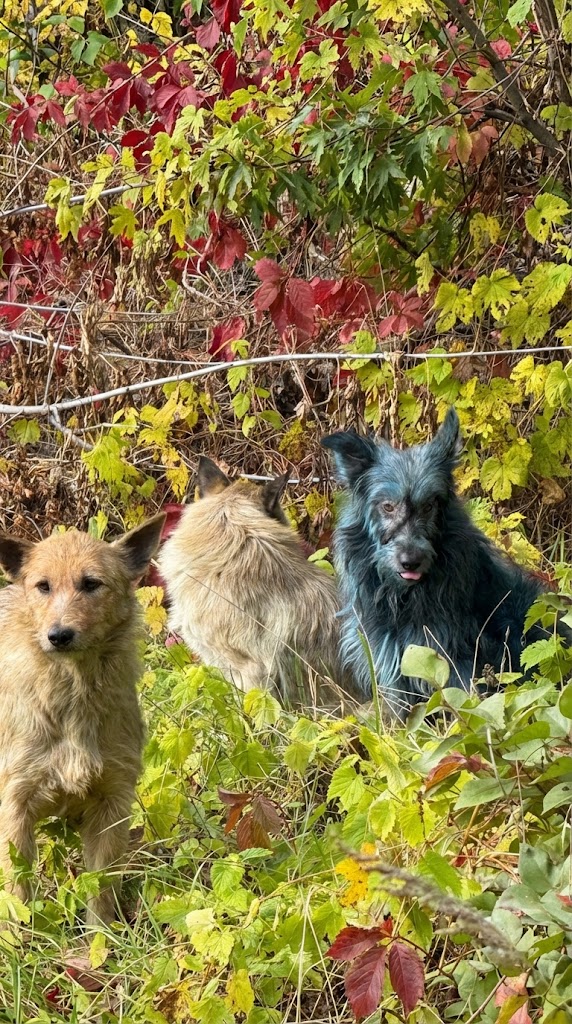
Some places carry history in ruined buildings and empty streets.
Inside the Chernobyl Exclusion Zone, history also walks on four paws.
Nearly four decades after people were evacuated following the 1986 nuclear disaster, descendants of the pets left behind still live among the abandoned areas surrounding the site. They have survived cold winters, limited food, disease, isolation, and an environment where radiation remains a concern for the people who enter.
Then several of those dogs suddenly appeared with something no one expected.
Their fur was bright blue.
In almost any other place, blue-coated dogs would have been strange enough. In Chernobyl, the sight immediately raised a much darker question.
Had radiation finally caused a visible mutation?
The images spread quickly because the explanation seemed almost too obvious to ignore. These animals had lived for generations in one of the world's most famous nuclear disaster zones. Seeing blue fur made it easy to imagine a disturbing connection.
But Chernobyl's newest mystery would turn out to have a surprisingly ordinary explanation.
When Blue Fur Sparked a Much Bigger Question
The dogs were noticed by people working with the Clean Futures Fund, an organization involved in monitoring and caring for the stray animals living inside the exclusion zone.
At first glance, the color was startling.
These were not dogs with a faint tint in their coats. Their fur appeared noticeably blue, making them stand out against the muted surroundings of the abandoned zone.
Given their location, speculation was inevitable.
Radiation is invisible, and the long-term effects of the Chernobyl disaster remain part of scientific study decades after the accident. For people seeing photographs online without additional context, the blue dogs seemed like something from a science-fiction story.
Yet appearances can be misleading.
The animals themselves were reportedly energetic and alert. Aside from their unusual color, there was no immediate indication that the blue coating represented some dramatic new illness or mutation.
Investigators simply needed to discover what the dogs had gotten into.
VIDEO: The Blue Dogs of Chernobyl Looked Mysterious — Then Investigators Found the Unexpected Cause
The Explanation Was More About Dogs Than Radiation
Once veterinarians and workers looked more closely, the mystery became considerably less frightening.
The likely source was not radiation.
It was a leaking portable toilet.
Dr. Jennifer Betz explained that the dogs appeared to have rolled in a substance that had attached itself to their coats. The material was believed to be a chemical dye associated with an old portable sanitation system.
In other words, the dogs had apparently discovered something messy and then behaved exactly as many dogs do when they encounter an unusual smell or substance.
They rolled in it.
The result happened to be dramatic enough to make them look completely different.
For people who had immediately connected the blue fur with nuclear radiation, the explanation was almost anticlimactic. But it also offered reassurance.
There was no evidence in the account that these dogs had suddenly developed blue fur through mutation. Their unusual appearance was external, and the color was expected to fade, wash away, grow out, or disappear naturally as their coats changed.
The incident became a useful reminder that extraordinary-looking situations do not always have extraordinary causes.
Sometimes a blue dog is simply a dog that found the wrong puddle.
Their Real Story Is More Remarkable Than the Color
The blue coating may have brought international attention to these animals, but their color is only a small chapter in a much larger story.
An estimated 500 dogs currently live within the Chernobyl Exclusion Zone.
They are believed to descend from pets that were left behind when residents were evacuated after the 1986 disaster. Families had little control over the sudden circumstances surrounding the evacuation, and many animals remained in the region after people were gone.
Those animals had to survive without the homes and people they once depended on.
Generation after generation followed.
Today, their descendants live in an environment that remains difficult for both animals and humans.
Radiation levels in parts of the zone still require workers and volunteers to take precautions, including protective equipment and radiation monitoring devices. Access is controlled, and some locations remain more hazardous than others.
For the dogs, radiation is only one part of the challenge.
Food can be difficult to find.
Winters are severe.
Groups of semi-feral dogs can face disease and uncontrolled breeding without veterinary support.
Yet they remain.
Their continued presence has turned them into living reminders of what was left behind when human life disappeared from the region.
A Population Scientists Are Still Trying to Understand
The Chernobyl dogs have also drawn scientific attention.
Genetic research has found that dogs living around the exclusion zone can be distinguished from other dog populations in the surrounding region.
Exactly why those differences developed is a more complicated question.
Isolation can shape animal populations over generations. Environmental pressures may also play a role, and researchers continue to study how life in and around Chernobyl has changed since the disaster.
What the blue dogs do not provide is simple proof of radiation-driven mutation.
Their strange coloring had a far more immediate explanation.
The wider population, however, remains scientifically important because these animals and their ancestors have spent decades living in a landscape dramatically altered by human activity.
Their story is therefore not simply about abandoned pets.
It is also about adaptation, isolation, and the way life continues in places people once believed had been emptied.
For visitors and workers, seeing the dogs can make the history of the disaster feel unexpectedly personal.
Buildings can decay.
Metal can rust.
Roads can disappear beneath vegetation.
But an animal waiting near those same places creates a different kind of connection to the past.
The People Who Continue to Return for Them
Although the dogs have learned to survive without traditional owners, they have not been completely forgotten.
Since 2017, volunteers and veterinary teams have worked inside the exclusion zone to help manage and protect the animal population.
Their work has included vaccinations, sterilization, tagging, health monitoring, and other forms of basic veterinary care.
According to the source, more than 1,000 dogs and cats have received treatment through these efforts.
That care matters for several reasons.
Vaccination can reduce the spread of preventable disease. Sterilization helps limit uncontrolled population growth. Tagging and monitoring allow teams to learn more about the animals they encounter repeatedly.
But even the simplest form of assistance can make an enormous difference.
Food.
Reaching these dogs is not as straightforward as driving into an ordinary neighborhood with bags of kibble.
The exclusion zone includes checkpoints, restricted areas, and locations where radiation levels must be monitored carefully. People working there have to follow safety procedures while carrying supplies into places most people will never enter.
Still, they return.
And the dogs have learned that human footsteps do not always mean abandonment.
Sometimes they mean food is coming.
The feeding missions reveal another side of Chernobyl that dramatic photographs cannot fully capture.
These dogs are not symbols wandering through a history book.
They are living animals with daily needs.
They become hungry.
They require medical care.
They gather where food is available.
They depend, at least partly, on the people willing to enter the zone and continue helping them.
What the Blue Dogs Really Represent
One of the blue-coated dogs photographed was identified as Lady.
Lady and the other strangely colored dogs attracted attention because their appearance seemed to fit the image many people already had of Chernobyl: a place where radiation had transformed nature into something unfamiliar.
But the truth is quieter.
The blue color was temporary.
Eventually, the substance on the dogs' coats should disappear.
Their real circumstances will remain.
These animals are still living in the shadow of an event they did not create and could never understand.
They cannot know why villages emptied.
They cannot understand why fences surround the land.
They do not know why humans entering some areas carry dosimeters and protective equipment.
They simply continue living where generations before them survived.
That may be the most remarkable part of the story.
Life Continued After People Left
The dogs of Chernobyl offer several lessons, but perhaps the most important is how easily appearances can distract us from the deeper story.
Bright blue fur naturally attracts attention.
It creates photographs people remember.
It raises dramatic questions.
Yet once the mystery was explained, something more meaningful remained behind.
There are hundreds of dogs living inside a place most humans abandoned decades ago.
Some receive food and veterinary attention because volunteers continue to return for them.
Researchers study their populations because their history may help scientists understand how isolation and environmental conditions shape animals over generations.
And every day, they continue doing what their ancestors did after the evacuation.
Surviving.
Nature can be remarkably persistent, even in landscapes changed by human disaster.
Strange appearances do not always mean frightening biological changes.
And compassion does not necessarily end at a checkpoint or a warning sign.
The blue coloring will eventually disappear from Lady and the other dogs.
Their story should not disappear with it.
Because the most important thing about Chernobyl's dogs was never the color of their fur.
It was the fact that, decades after people were forced to leave, life remained behind — still adapting, still enduring, and still depending on the moments when someone chooses to come back.


