
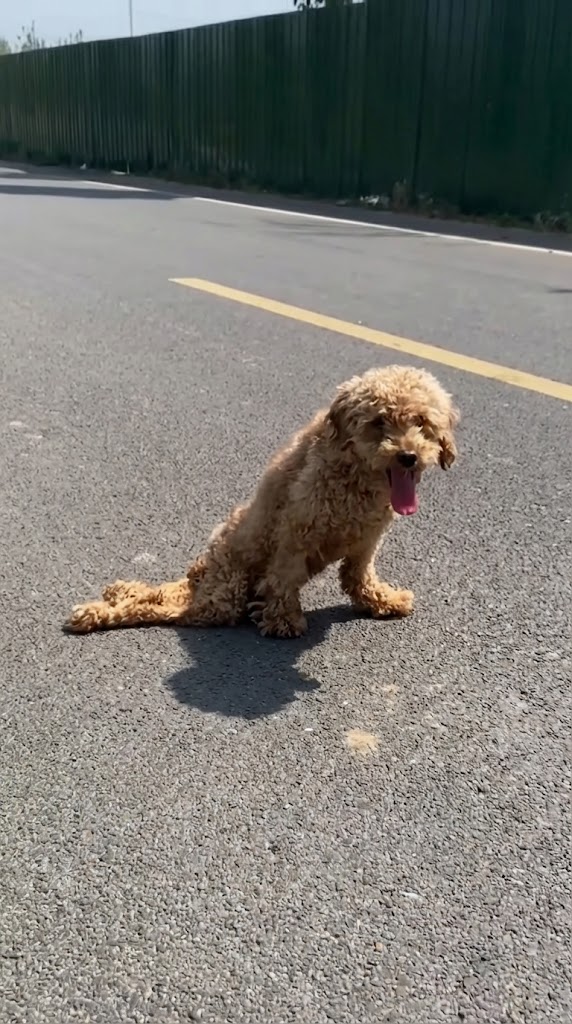
Some dogs ask for help with a bark or a cry.
Tiao Tiao could only keep moving.
When he was discovered beside a dusty road, his hind legs could no longer carry him. Instead of walking, he pulled his entire body forward with his front legs, inch by exhausting inch.
After moving only a short distance, he had to stop.
His shoulders trembled from the effort. His breathing was rough. His back legs simply followed behind him as he dragged himself across the ground.
Yet there was something striking about the way he looked at the people who found him.
His body was struggling.
His spirit did not seem ready to disappear.
A Diagnosis That Changed Everything
Tiao Tiao was taken to a hospital, where the examination brought difficult news.
According to the source, neuritis had caused him to lose sensation in the lower part of his body. No one could promise that he would someday walk normally again.
That uncertainty could not change one decision.
Whether Tiao Tiao ever stood on four legs again or not, he would no longer have to face life completely on his own.
He was given the name Tiao Tiao.
And from that point forward, the focus was no longer simply on what his body could not do.
It was on giving him every reasonable opportunity to discover what it still could.
The beginning of that journey was difficult to watch. His front legs carried nearly all the burden as he moved, while the rest of his body followed behind.
But even during those earliest days, the gentle expression that would later become so familiar was already there.
VIDEO: He Was Crawling Along the Road on Two Working Legs — Then His Fight Back Began
Learning That the Yard Was Safe
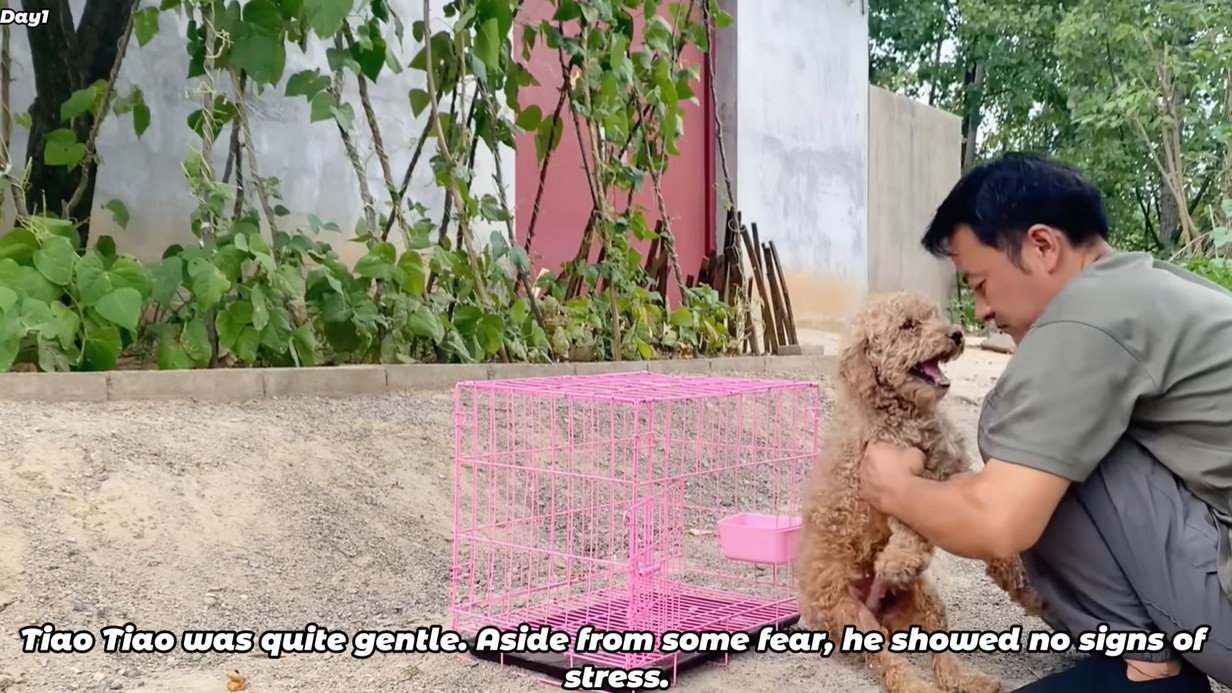
To give Tiao Tiao a quieter environment, he was moved to a countryside yard away from the noise and movement of busy roads.
Freedom, however, did not immediately feel like freedom to him.
At first, the large open space seemed unfamiliar. He preferred staying curled inside his cage, remaining close to the small area that felt predictable and secure.
No one forced him out.
He was simply given time.
Gradually, curiosity began replacing hesitation.
Before long, Tiao Tiao was no longer content to remain inside. Using his powerful front legs, he began moving around the courtyard and even chasing after the people caring for him.
It was not conventional running.
But to anyone who remembered the dog barely making his way along the roadside, it represented something much bigger.
Tiao Tiao was participating in life again.
His personality also became clearer as he settled into the yard. He was described as unusually gentle and patient. He rarely complained and remained cooperative even when his condition created difficulties he could not control.
Because he had limited control over his lower body, even basic daily routines could be complicated.
At times, his expression appeared almost apologetic when caregivers cleaned up after him.
There was nothing for him to apologize for.
He simply needed care.
And now, someone was there to provide it.
Fighting for the Smallest Possibility
Recovery did not arrive quickly.
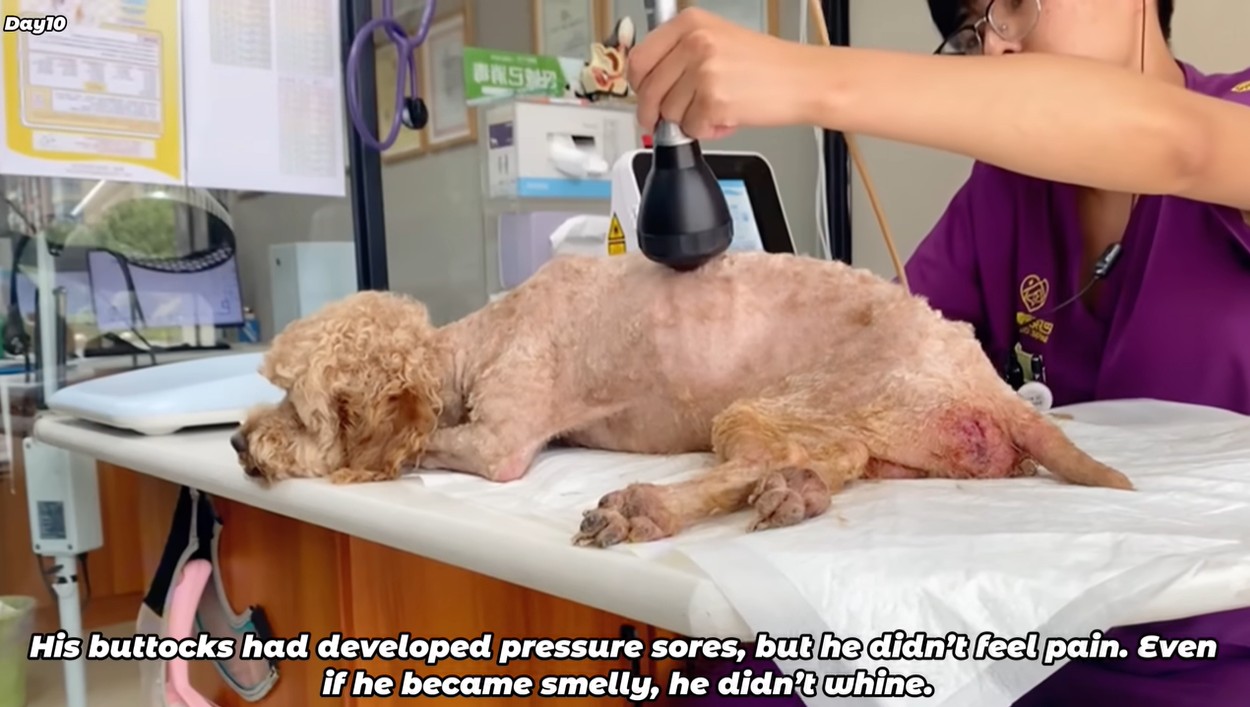
By Day 10, further examination showed severe nerve compression. Constantly dragging his lower body had also caused significant irritation and pressure-related injuries around his hips and rear.
For dogs with paralysis, protecting these vulnerable areas can become an important part of long-term care.
The situation left Tiao Tiao's caregivers facing a difficult choice.
Surgery carried risks, substantial expense, and no guarantee that it would restore his mobility.
Instead, they chose a slower path centered on rehabilitation, including acupuncture, electrotherapy, and physical therapy.
Progress would have to be measured differently now.
Not in miles.
Not even in steps.
Sometimes it would be measured in the smallest physical response.
The sessions could be uncomfortable, especially as treatment attempted to stimulate nerves that had shown so little response.
Through them, Tiao Tiao remained remarkably calm.
He did not snap or struggle to get away.
When a session became particularly difficult, he would sometimes close his eyes and remain still until it passed.
On some occasions, a tear could be seen on his face.
Those moments made the quiet determination of his rehabilitation especially difficult for his caregivers to forget.
They stayed near him through the sessions, offering comfort while continuing to work toward a possibility no one could guarantee.
There was still no certainty that he would walk again.
But there was enough hope to continue.
The Day His Legs Began to Respond
Then came Day 22.
Something changed.
Tiao Tiao began showing returning sensation in his legs.
It was not a complete recovery, and it did not suddenly allow him to stand and walk normally.
But after weeks in which uncertainty had defined almost everything, even that small response mattered.
His rehabilitation continued at home.
Caregivers worked with him regularly, supporting his body and helping him exercise while watching closely for further changes.
They also introduced something that would transform his independence: a custom rehabilitation cart.
The cart supported Tiao Tiao's rear body while allowing his strong front legs to propel him forward.
For a dog who had previously dragged himself across the ground, the difference was enormous.
Suddenly, movement did not have to mean scraping his lower body along the surface.
He could lift himself into position.
He could move more freely.
He could explore.
And he could begin discovering just how much energy had been waiting inside him all along.
From Crawling to Racing Down Country Roads
The weeks became months, and Tiao Tiao continued adapting.
By Day 117, he had received a higher-quality cart that gave him even greater freedom of movement.
Soon he was not merely rolling slowly through the yard.
He was jogging.
His front legs moved quickly while the wheels supported him from behind, carrying him along the countryside roads with a confidence that seemed almost impossible compared with the dog first seen crawling on the pavement.
His rescued companions became part of the routine too.
Tiao Tiao even formed what his caregivers affectionately regarded as a small patrol group. He would head along the road with the other dogs following nearby, as though the countryside had become his territory to inspect.
Among them was Ping An, one of his canine companions.
Together, they turned an ordinary outing into something joyful.
There was no need to pretend Tiao Tiao's paralysis had disappeared.
It had not.
What had changed was the amount of life he could experience despite it.
The cart did not make him less determined.
It simply gave that determination somewhere to go.
Progress Measured in Seconds
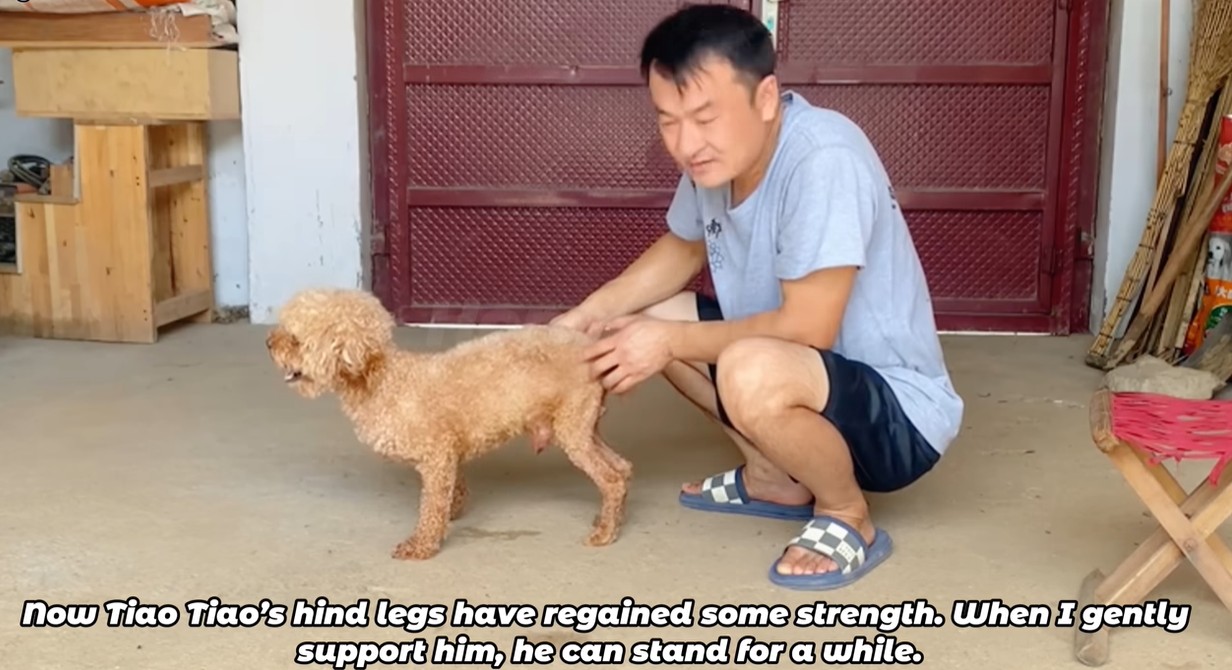
Tiao Tiao's rehabilitation has continued well beyond those first months.
He still cannot fully stand and walk independently.
But he can now support himself for a few seconds at a time.
To someone watching casually, a few seconds might not seem remarkable.
For Tiao Tiao, they represent months of patient work.
They represent nerves beginning to respond.
They represent caregivers who kept going when the outcome was uncertain.
Most importantly, they represent progress without demanding perfection.
His days are no longer defined by a dusty road and the exhausting effort of pulling himself forward.
He can spend time outside in the sunshine.
He can move around the yard.
He can play near the other dogs.
And with his cart beneath him, he can race forward with the same enthusiasm as companions whose legs never failed them.
A Life That Became Bigger Than His Disability
Tiao Tiao's journey is still unfinished.
There is no guarantee about exactly how much mobility he may eventually regain, and his caregivers continue to work within the limits of his condition.
But his story has already changed dramatically.
The frightened dog who once remained inside his cage gradually learned to enjoy an open yard.
The dog who dragged his hindquarters along the pavement learned to move with the help of wheels.
The patient who began rehabilitation with little certainty eventually regained some sensation and the ability to support himself briefly.
None of those changes happened all at once.
That may be the most meaningful part of his story.
Recovery does not always arrive as one dramatic moment.
Sometimes it appears as a tiny response during therapy.
Sometimes it is a few seconds spent standing.
Sometimes it is a dog racing down a country road in a cart, surrounded by companions.
Tiao Tiao continues to move forward in whatever way his body allows.
Perhaps one day he will need the cart less.
Perhaps his progress will continue slowly.
Whatever comes next, he no longer has to measure the journey alone.
The road that once forced him to crawl has been replaced by a place where he can move, rest, play, and keep trying.
And through every stage, one thing has remained remarkably familiar:
Tiao Tiao's smile.


