
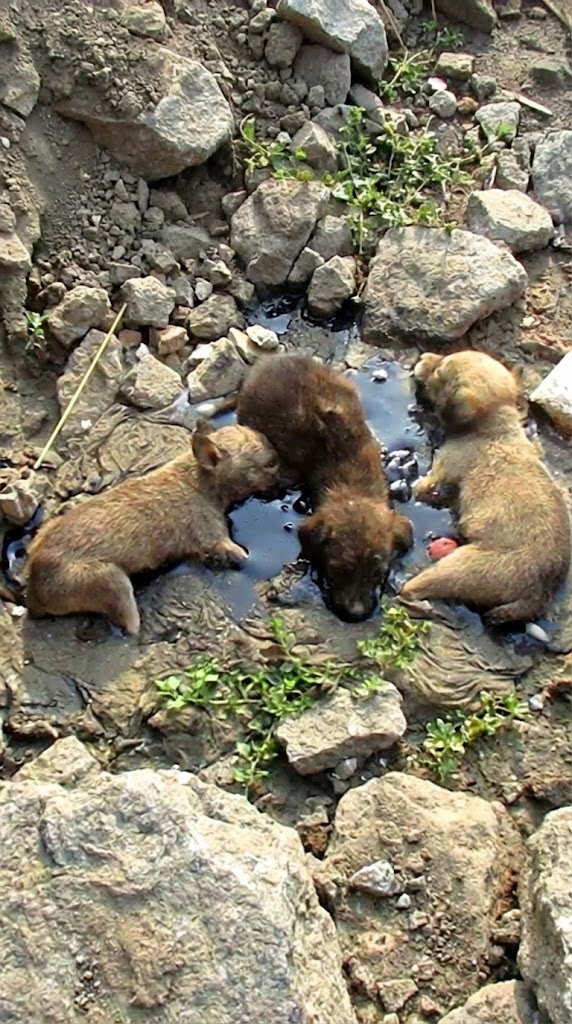
A dark patch on the ground looked harmless until three tiny puppies stepped into it.
What appeared to be a simple puddle was actually thick tar.
Within moments, their paws were caught. The more the young dogs tried to pull away, the more the sticky substance clung to their bodies.
They twisted, kicked, and cried as they struggled to escape, but the tar gave them almost no room to move.
One puppy became trapped so severely around the face that its mouth was held open by the hardened material. The others were frightened and exhausted, their cries continuing until someone finally heard them.
What had begun as ordinary curiosity had turned into a situation the puppies could not escape on their own.
The Ground Had Become Part of the Trap
When rescuers from Animal Aid Unlimited reached the puppies, the difficulty of the situation quickly became clear.
The tar was no longer simply coating their fur.
It had hardened around them and mixed with the soil beneath their bodies.
Trying to pull the puppies upward could have caused further injury to their delicate skin. The rescuers needed another approach.
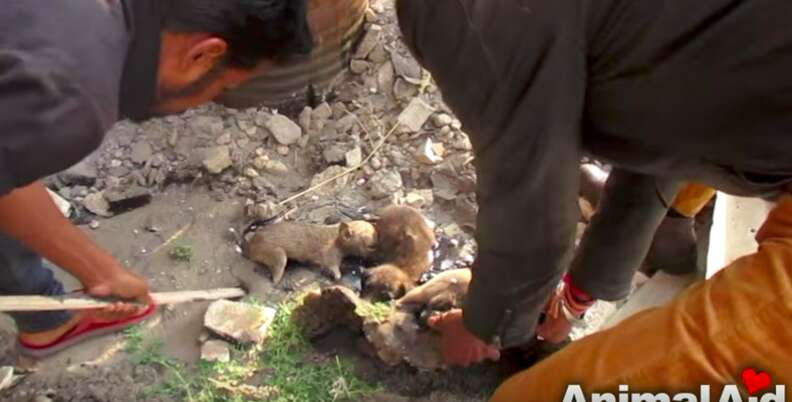
Instead of forcing the puppies out of the tar, they began carefully cutting away the earth surrounding them.
Piece by piece, sections of hardened tar and soil were separated from the ground. The puppies had to be lifted together with the heavy material that still surrounded their bodies.
It was careful, demanding work.
Every movement had to protect the puppies while gradually freeing them from the place where they had become trapped.
Eventually, all three were removed from the ground.
But being lifted to safety was only the beginning.
Large amounts of black tar still covered their fur and bodies, and the puppies were already tired from struggling.
Getting Them Free Was Only the First Step
The puppies were taken for care, where rescuers faced a completely different challenge.
The hardened tar could not simply be washed away.
Removing it would require patience rather than force.
Oil was gently applied to their fur and worked into the thick coating. The process was repeated carefully, with rescuers massaging the affected areas and waiting for the tar to begin loosening.
There was no quick result.
After two hours, much of the substance remained stubbornly attached.
The puppies were weak and frightened, but they stayed relatively still as the rescuers continued working around them.
Slowly, the oil began doing what pulling and scraping could not safely accomplish.
The hard black coating started to soften.
Small sections began separating from the puppies' fur.
For the first time since becoming trapped, their bodies could begin moving more freely.
VIDEO: Three Puppies Were Trapped in Hardened Tar — Then Rescuers Began the Delicate Work of Setting Them Free
Hours of Patience Began to Change Everything
There was no single moment when all the tar suddenly disappeared.
The process had to continue gradually.
Oil was applied again and again, allowing the rescuers to loosen the substance without relying on harsh force.
Each bit of progress revealed more of the puppies beneath the dark coating.
The work was slow, but it was working.
Eventually, the puppies were able to stand again.
That simple movement marked an important turning point.
Only hours earlier, they had been unable to free even their paws from the ground. Now their legs could move beneath them again.
Yet their care was far from complete.
Tar still remained in their coats, and removing all of it would take considerably longer than the first rescue.
Three Days of Gentle Cleaning
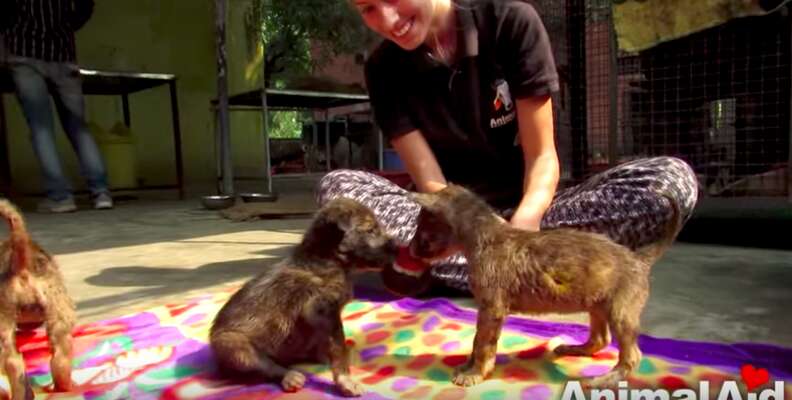
Over the next three days, the puppies continued receiving repeated oil massages and careful baths.
Little by little, the black coating disappeared.
Their natural fur became visible again.
With each cleaning, the puppies looked less like the frightened animals that had been lifted from hardened tar and more like themselves.
Their behavior also began to change.
They started eating.
Their tails began to wag.
Before long, they were playing again.
These were ordinary puppy behaviors, but after what they had endured, every small sign of energy showed how far they had come.
Recovery was not one dramatic transformation.
It happened through repeated acts of care.
A little more tar removed.
A little more movement.
A little more confidence returning.
Day by day, the three puppies moved farther away from the frightening place where they had once been unable to escape.
One Important Piece Was Still Missing
Saving the puppies' lives was already a remarkable outcome.
But the rescuers hoped to restore something else that had been lost during the ordeal.
Their family.
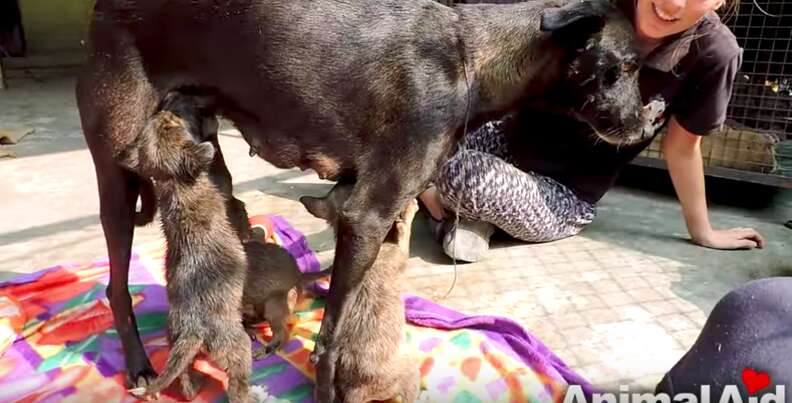
The team managed to locate the puppies' mother.
When she was brought to them, recognition appeared immediate.
The puppies rushed toward her with excited cries and wagging tails. After days surrounded by unfamiliar hands and careful treatment, they were finally beside the dog they knew best.
Their mother was there.
The three puppies who had once been immobilized in tar were now moving freely around her.
It was a reunion that transformed the end of their rescue.
They had not only survived.
They had found their way back to their family.
From a Black Trap Back to Puppy Life
The contrast was difficult to miss.
At the beginning, the puppies could barely move.
Their bodies were caught in hardened tar, and struggling only made escape more difficult.
Rescuers could not solve the problem with strength. They had to cut away the ground itself and then spend hours gently softening what remained.
The following days demanded the same kind of patience.
There was no shortcut.
Only careful hands, repeated cleaning, and enough time for three exhausted puppies to recover.
Eventually, the dark coating that had covered them was gone.
They could eat, wag their tails, play, and stay close to their mother once more.
Their rescue is a reminder that helping an animal is sometimes less about one dramatic action and more about refusing to give up when progress comes slowly.
Force could not safely free these puppies.
Patience could.
And after three days of careful care, three little dogs who had been trapped almost completely still were once again doing what puppies were meant to do—
moving, playing, and staying close to their mother.


