
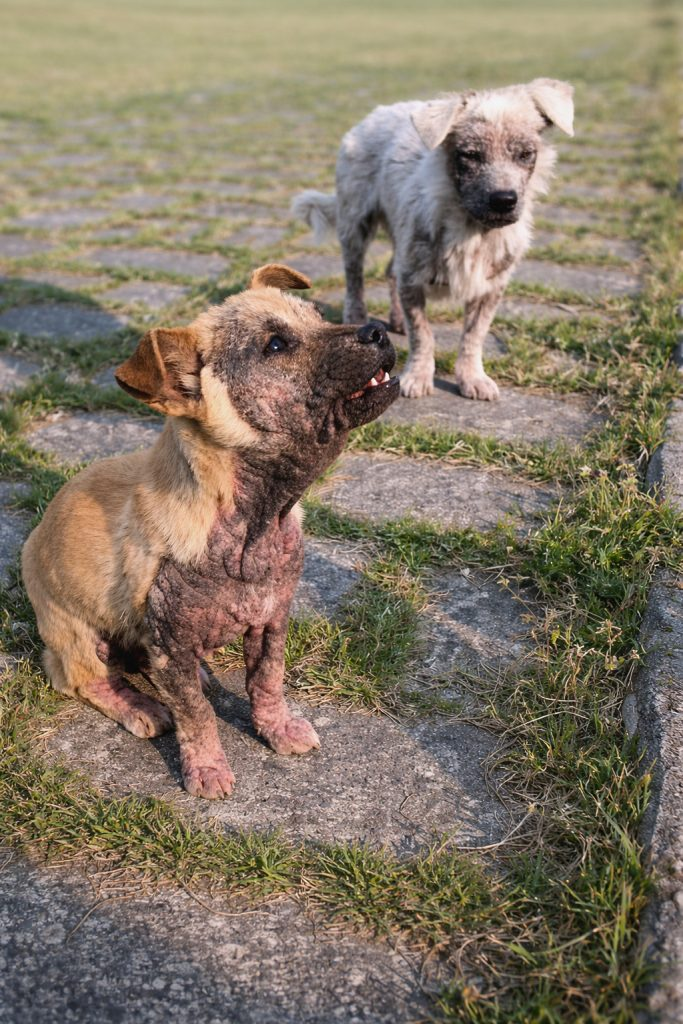
It started with a few careless words typed online and quickly forgotten: “Those two dogs are ugly.”
No context. No concern. No follow-up. Just a passing comment that disappeared into the endless scroll of the internet. For most people, it meant nothing at all. For two young dogs fighting to survive, it came dangerously close to sealing their fate.
Two Brothers Who Wouldn’t Separate
Their names were Eundong and Geumdong. Brothers, barely a year old. For weeks, they drifted near a campsite, living on the edges of human presence, surviving mostly because they had each other. Campers came and went. Cars passed. Voices echoed nearby. And still, no one stopped.
When rescuers finally found them, their bodies were thin and exhausted — but the two brothers were still side by side. Still waiting.
A Pattern Neither of Them Deserved
Rescue workers from Youumbba learned about the dogs through reports that felt painfully familiar. Two underweight dogs hovering near a campsite, approaching cautiously, backing away at the smallest movement. Never begging. Never barking. Just waiting.
Their behavior told its own story — hunger mixed with fear, hope followed quickly by retreat. Rejection had become something close to routine. Some campers waved them off. Others complained. Most simply looked away. When no food appeared, the brothers would disappear into the tall grass, choosing to stay unseen rather than be chased off again.
As the days went on, desperation set in. Eundong, the white-coated brother, began eating grass — not out of curiosity, but out of pure survival. By the time rescuers finally set out to find them, four long days had passed. The area was busy, and there was real fear that the brothers could vanish without anyone ever noticing.
But they were still there.
The First Time Someone Chose Them
When rescuers approached, both dogs stood up at once, their bodies tense, their paws hesitant. Then the smell of food reached them.
They ate quickly — not aggressively, but urgently, as if the meal might disappear at any second. One rescuer later said it felt as though the dogs had already accepted that no one wanted them. Watching them eat in silence, hunched low to the ground, left a mark she wouldn’t soon forget.
Up close, the damage was significant. Their paws were swollen and irritated. Their fur was thin and patchy across fragile frames. And yet, in the middle of it all, Geumdong quietly pressed his head into a rescuer’s chest — no struggle, no fear, only pure exhaustion finally allowed to show.
VIDEO: Two Brothers Called “Ugly” and Forgotten — Until Someone Finally Stopped
What Hunger Had Done to Their Bodies
Long-term hunger doesn’t just weaken a body — it changes behavior. Veterinarians explained that severely malnourished dogs sometimes begin consuming non-food items, a condition known as pica. It isn’t a choice. It’s desperation.
X-rays confirmed it. Both brothers’ intestines held stones, plastic, and other debris — anything they had been able to swallow to dull the pain of hunger.
The rescue itself grew tense at one point. When the team tried to secure Eundong, panic took over and he bolted, forcing the team to use a net to keep him from running into danger. Locals later shared more of the picture: the brothers had first appeared nearly two months earlier. No owner ever came forward. No one asked where they had come from.
How They Had Kept Each Other Alive
During the drive to safety, the reason behind their survival became clear. Eundong ate quickly, but kept watching Geumdong the entire time, pausing mid-meal to check on his brother, only finishing once he was sure Geumdong had eaten too.
They had been sharing everything — every scrap, every chance at food. It explained why Eundong had turned to eating grass in the first place: so his brother wouldn’t go hungry in his place.
At the veterinary clinic, separation became unavoidable, and it was hard on both of them. For the first time, the brothers were placed in different spaces. Eundong cried and trembled, and staff worked to keep the two within sight of each other whenever they possibly could.
A Long Road Back to Health
The diagnoses were serious: advanced demodectic mange, parasites, severe anemia, and extreme malnutrition. Their skin was fragile and needed gentle, careful handling.
Eundong’s condition was the most critical. He required IV fluids and a period of isolation to stabilize. Geumdong battled a high fever, and for a while, his outcome wasn’t certain either.
The first week was entirely about survival — gentle feeding, medicated baths, and around-the-clock monitoring. At first, the brothers barely moved. Then, slowly, their tails began to lift. Their eyes started following movement around them. Life was beginning to come back.
By day fifteen, real progress was visible. Geumdong’s fever finally broke, and both brothers’ appetites grew stronger. By day thirty-five, the transformation was undeniable. Soft fur had grown back in. The swelling in their paws had faded. Legs that had once trembled now carried them with steady, confident steps.
Together, and Finally Safe
When they left the hospital, they were almost unrecognizable compared to the two exhausted dogs found near that campsite weeks earlier.
Both brothers were eventually adopted — each into a family who saw past the scars and the hardship straight to who they really were. They weren’t ugly. They were never unwanted. They were survivors who had simply needed someone to look a little closer.
What Their Story Leaves Behind
Eundong and Geumdong made it because they refused to leave each other’s side, and because compassion finally arrived before it was too late. Their story is a quiet reminder of how careless words can wound more than anyone intends, and how patience and care can change everything once someone finally chooses to look.


