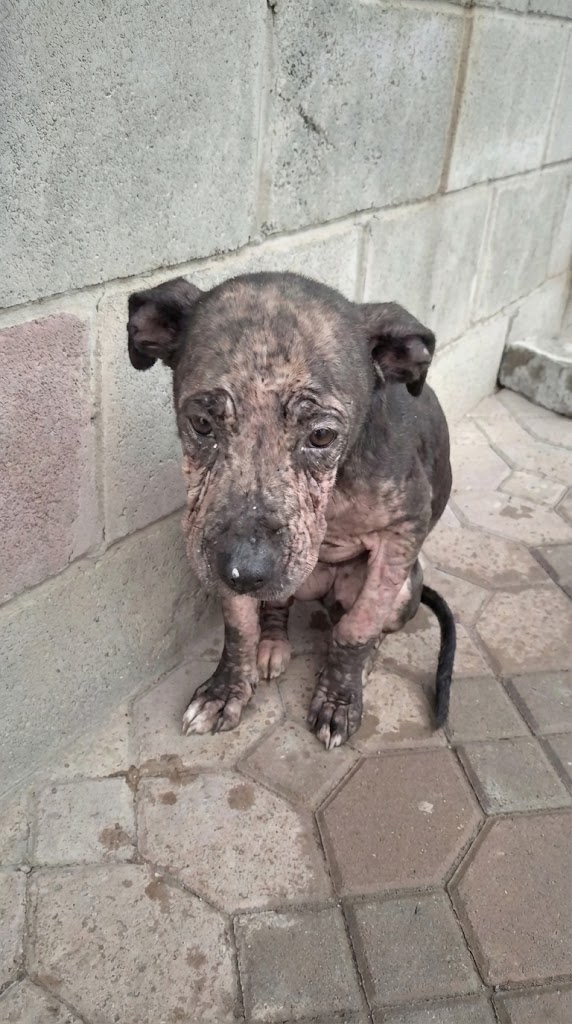
In the middle of a merciless winter, a fragile, nearly hairless figure sat motionless against icy pavement outside a small store.
A Shadow, Not a Dog
She looked more like a shadow than a living animal.
This was Stesha.
Once, she had belonged to someone. Once, she had been someone’s responsibility. But the moment illness stole her beauty and strength, she was no longer wanted. She was carried outside and left behind entirely, abandoned at the exact moment she needed real help the most.
Snowflakes landed softly onto her bare, inflamed skin. With no fur left to protect her, every single flake felt like a small needle against exposed skin. Her body had been ravaged by severe mange, leaving her skin raw, dark red, and painfully exposed to the cold. Frostbite had already begun its quiet, damaging work.
She didn’t cry. She didn’t bark. She didn’t move.
All she could do was sit there, slowly lifting and lowering her thin paws, one at a time, as though waiting for something — either a miracle, or an ending.
When a rescuer finally lifted her, Stesha didn’t resist at all. She collapsed into their arms and lost consciousness almost immediately, as though her body had finally decided it was safe enough to rest.
VIDEO: Left to Freeze — Stesha’s Astonishing Fight for Survival
When Hope Seemed Nearly Impossible
At the veterinary clinic, the difficult truth arrived in waves.
First came severe frostbite. Then pneumonia. Then advanced mange.
But the most serious news arrived several days later.
Stesha tested positive for canine distemper virus, often referred to in rescue circles as “the plague.”
Distemper is a ruthless illness. It attacks the lungs, the digestive system, and most devastatingly, the brain itself. Many dogs never survive it, and those who do often carry lasting neurological effects.
Soon, Stesha began suffering violent seizures. High fevers overwhelmed her tiny body. Her muscles twitched uncontrollably, rarely allowing her a single moment of real peace.
To many observing her case, it looked like an outcome that had already been decided.
The Heart of a Fighter
Stesha clearly didn’t agree.
Around day fifteen, something unexpected happened.
She tried to move.
Her legs no longer obeyed her properly, bending awkwardly beneath her in an uncomfortable half-crouch. She couldn’t stand. She couldn’t walk.
So she crawled instead.
She dragged herself forward, inch by determined inch, collapsing again and again, but always trying just one more time.
By day twenty-eight, her caregivers had started calling her their little warrior.
Not because she was physically strong.
But because she absolutely refused to stop trying.
Her body trembled constantly, but her will never once wavered.
Healing Takes Real Time
Recovery from distemper is rarely dramatic.
It’s quiet. Slow. Relentless, in the best possible sense.
It happens in tiny, easily overlooked moments.
By day forty-six, Stesha was transferred to a specialized rehabilitation center, where every single movement became its own exercise, every step its own hard-won lesson.
By day one hundred sixty, something incredible finally happened.
She walked.
Not perfectly. Not smoothly.
But entirely on her own.
By day two hundred seventy, the transformation had become completely undeniable. The frozen, hairless shadow once found on that sidewalk no longer existed at all.
In her place stood a healthy, glowing dog with a genuine future ahead of her.
What Stesha’s Story Leaves Behind
Stesha wasn’t abandoned because she was dangerous.
She wasn’t abandoned because she was aggressive.
She was abandoned simply because she had become inconvenient.
And yet, she became a powerful symbol of what real perseverance looks like, even inside a small, broken body.
Her journey leaves behind a few important truths. The word “hopeless” is often simply wrong. Warmth alone can save a life. And sometimes, real courage doesn’t look like running at all.
Sometimes, it looks exactly like crawling forward, one painful inch at a time.
Stesha is no longer the dog once left behind in the snow.
She stands instead as proof that miracles don’t always arrive suddenly.
Sometimes, they crawl toward us, one determined inch at a time, until finally, they stand.